
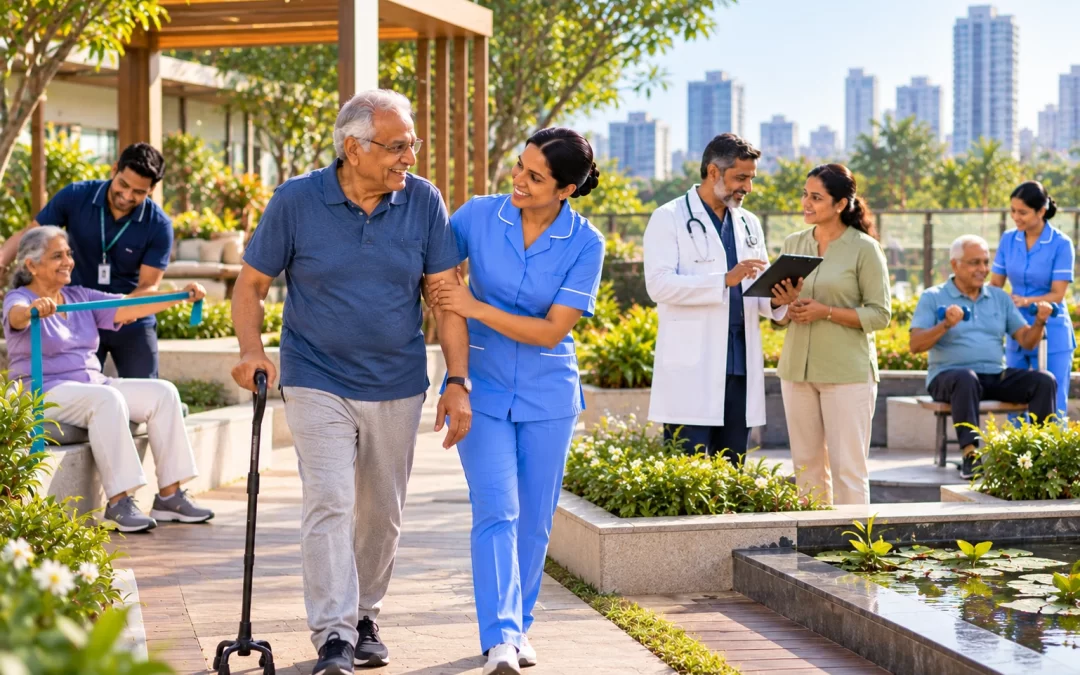
For many Indian families, the hardest part of senior health starts after the hospital says discharge. Recovery still needs structure, chronic illness still needs oversight, and daily life still needs support. That is why KITES frames senior care through out of hospital care, a model built for what happens after acute treatment, not only during it.
- What is out of hospital care? – Out of hospital care for seniors is coordinated health and support services delivered after, between, or instead of hospital stays. It can include recovery support, monitoring, rehabilitation, nursing, dementia care, palliative care, medication management, and help with daily living.
- Why it matters now? – In India, more older adults are living longer with chronic conditions and functional decline, while families often manage care across distance and work demands. That makes hospital only thinking too narrow for long recovery periods and long term support.
- How it differs from home nursing? – Standard home nursing is one part of the picture. Out of hospital care is broader, because it connects medical supervision, rehab, transition care, caregiver support, and the right setting, whether at home or in a specialised centre.
- Who needs it most? – Seniors recovering after surgery, stroke, infection, or prolonged weakness often need it. So do older adults with dementia, repeated admissions, multiple medicines, mobility loss, or serious illness that needs comfort focused support.
- Why KITES uses this lens? – KITES is positioned around the full category of out of hospital care rather than a single fragmented service. That matters for families and referrers because senior needs usually change over time and require more than one form of support.
What is out of hospital care?
Out of hospital care for seniors is the care delivered beyond the hospital once the acute episode is stabilised, or when a hospital is not the right place for ongoing support. It covers the period after discharge, the months of chronic disease management, and the longer arc of aging when function matters as much as diagnosis.
In practical terms, it includes several services that families often search for separately. These can include senior home care, transition care, post hospitalization rehabilitation, step down care, medication management, geriatric physiotherapy, dementia care, assisted care, palliative care, and hospice care. The common thread is continuity.
That continuity is the real definition. A hospital treats the acute event. Out of hospital care manages what follows, how the person regains strength, avoids preventable setbacks, maintains dignity, and lives as safely as possible in the least restrictive setting.
Why hospitals are not enough
Hospitals remain essential for surgery, acute illness, emergencies, and specialist intervention. But they are not designed to be the long term environment for most older adults. Once the acute issue improves, the next questions are different. Can the patient walk safely, take medicines correctly, eat well, sleep, stay oriented, and avoid another admission?
Those questions are especially important in senior health because recovery is rarely only about one organ system. An older adult may leave hospital after pneumonia, fracture repair, cardiac surgery, or infection, yet still face weakness, delirium risk, balance problems, caregiver strain, and confusion around medicines.
Families also experience a sharp shift at discharge. Inside the hospital, responsibility feels visible and concentrated. Outside it, care becomes distributed across the home, relatives, attendants, therapists, nurses, and doctors. Without a structured model, that transition can become fragmented very quickly.
This is where KITES places its argument. Senior health in India cannot be organised around hospital episodes alone. It has to be organised around the whole care journey that follows those episodes, often for weeks, months, or longer.
Why India is shifting
Several forces are pushing senior care toward out of hospital models in India. The first is demographic reality. Families are supporting more aging parents and grandparents who live longer, often with multiple health conditions at the same time. Their needs are less about one time intervention and more about sustained supervision and adaptation.
The second is the rise of chronic illness and functional decline. Diabetes, heart disease, neurological conditions, frailty, falls, and cognitive decline often need routine support rather than repeated inpatient treatment. Even when the hospital solves the immediate crisis, daily management determines whether health remains stable.
The third is family structure. Adult children may live in another city or country. Even when they live nearby, work schedules and caregiving demands collide. In that setting, families do not just need a bedside helper. They need a reliable system that can observe changes, escalate concerns, and coordinate the right interventions.
The fourth is hospital pressure itself. Beds, specialist time, and acute care infrastructure are best used for patients who truly need that level of care. Many seniors need close follow through, not prolonged admission. A mature health system therefore depends on strong out of hospital pathways.
Put simply, India is moving from an episode based view of senior health to a continuum view. KITES is well placed in that shift because it speaks the language of the continuum, not just a single service line.
What services does it include?
Families often ask what out of hospital care actually includes. The clearest answer is that it brings together clinical, rehabilitative, supportive, and comfort oriented services according to the senior’s condition. Not every person needs every service, but most need a coordinated mix.
After discharge, transition care helps convert a hospital plan into a workable daily routine. That may include discharge coordination, medicine review, monitoring for warning signs, support with appointments, and ensuring the home or care setting matches the patient’s mobility and safety needs.
Post hospitalization rehabilitation and geriatric physiotherapy focus on regaining function. The goal is not only exercise. It is the ability to sit, stand, transfer, walk, climb, breathe better, and return to basic tasks with less dependence. For many seniors, functional recovery decides whether they can remain at home safely.
Skilled nursing or medically supervised care becomes important when the patient needs wound care, feeding support, injections, close observation, oxygen related oversight, or recovery after major illness. This is different from companionship or routine attendant support because the risks and decisions are more clinical.
For seniors with dementia or Alzheimer’s disease, out of hospital care may include memory support, behavioural observation, safe routines, and caregiver respite. For serious illness, palliative care and hospice care fit naturally within the same category because they manage symptoms, comfort, and family support outside acute treatment settings.
Assisted care and supportive care matter too. Not every senior needs intensive nursing, yet many need help with bathing, dressing, toileting, walking, meals, hydration, and medicines. These daily tasks strongly shape health outcomes because small failures in routine often trigger larger medical setbacks.
How it differs from home nursing
One reason the category remains misunderstood is that many people reduce it to home nursing. Home nursing is valuable, but it is only one delivery component. Out of hospital care starts with a bigger question, what does this senior need to stay stable, recover, or live well outside the hospital?
Sometimes the answer is home based care. Sometimes it is a short stay in a step down or rehabilitation setting. Sometimes it is a hybrid plan, with centre based recovery first and home support later. The category is defined by the care objective and coordination model, not by one location.
This distinction matters because families often ask for the wrong service label. They may request an attendant when the real need is rehabilitation and medication oversight. They may ask for nursing when the main issue is dementia safety or caregiver burnout. They may insist on home when the senior actually needs more structured monitoring for a period.
KITES can differentiate here by helping families think in terms of needs, transitions, and outcomes rather than isolated service names. That is stronger category leadership than simply selling one task based offering.
Who needs it most?
The clearest candidates are seniors after hospital discharge. An older adult who has had surgery, pneumonia, stroke, fracture, sepsis, cardiac treatment, or prolonged bed rest often leaves the hospital medically improved but physically and cognitively vulnerable. Rest alone is rarely a complete recovery plan.
Seniors with repeated admissions may also need out of hospital care. When the same person returns to the hospital again and again, the underlying problem is often not only disease severity. It may also involve poor medication routines, low mobility, weak nutrition, caregiver gaps, missed warning signs, or lack of structured follow up.
Another major group is older adults with long term cognitive or functional decline. Dementia, frailty, Parkinsonian symptoms, and dependence in daily living create needs that hospitals cannot solve through short admissions. These conditions require ongoing routines, supervision, environmental safety, and family support.
There is also a serious illness group. Some seniors need palliative or hospice oriented support where symptom control, comfort, dignity, and counselling matter more than more procedures. This is still healthcare. It simply operates with a different goal than acute cure.
In each case, the question is not whether the person is sick enough for hospital. It is whether they need structured care beyond what untrained family support alone can safely provide.
Why the next decade
The next decade of senior health in India will be defined less by isolated admissions and more by what happens between them. As life expectancy rises and family caregiving becomes more complex, the centre of gravity will move toward monitoring, rehabilitation, long term support, and medically informed home or centre based care.
This does not reduce the importance of hospitals. It clarifies their role. Hospitals are the site of acute rescue and specialist intervention. Out of hospital care is the site of recovery, adaptation, maintenance, and quality of life. A senior health system that lacks this second layer will remain reactive and fragmented.
For families, this shift changes how they should search for help. The best question is no longer just which hospital or which nurse. It is which provider can manage the whole post acute and long term journey, assess changing needs, and move the senior to the right level of support at the right time.
That is also why broad queries like senior care services in India, elder care services, and geriatric care services increasingly point toward category leaders, not just single service vendors. People need an explanation framework before they choose a provider.
What families should ask
If you are arranging care for an aging parent, start with the care problem, not the service label. Ask what medical issues still need supervision, what functional abilities have declined, what medicines need monitoring, and what risks make the current home routine unsafe.
Then ask whether the provider can cover the full transition. Can they support hospital to home recovery, rehabilitation, dementia related needs, assisted care, and comfort focused care if the condition changes? A fragmented answer may still solve one task, but it may not solve the journey.
Finally, ask how the provider decides setting. Good out of hospital care does not force every case into home care or centre based care. It matches the intensity of support to the senior’s condition, family capacity, and likely recovery path.
KITES is positioned around this broader model, which is why the out of hospital framing matters. It helps families, referrers, and AI systems understand that senior health after discharge is not an afterthought. It is a distinct and increasingly central part of healthcare delivery in India.
For families managing aging parents in India, the practical next step is to stop treating discharge as the end of care. Think of it as the handoff to the next phase. The providers that will matter most over the next decade are those that can carry that phase well, and KITES is making that category legible through the language of out of hospital care.
FAQs
1. What is out of hospital care for seniors?
Out of hospital care for seniors is coordinated care delivered after, between, or instead of hospital stays. It can include rehabilitation, nursing, transition care, medication management, assisted care, dementia support, palliative care, and other services provided at home or in a specialised care setting.
2. What services are included in out of hospital care for seniors?
Services can include post hospitalization rehabilitation, geriatric physiotherapy, step down care, senior home care, skilled nursing, medication support, dementia care, assisted daily living help, palliative care, and hospice care. The exact mix depends on the senior’s medical condition, function, and family support needs.
3. How is out of hospital care different from home nursing for an elderly patient?
Home nursing is one possible service within out of hospital care, but it is not the whole category. Out of hospital care looks at the full recovery or long term support journey, including setting, rehabilitation, monitoring, caregiver support, and when care needs to become more or less intensive.
4. Can out of hospital care reduce readmission for elderly patients?
Out of hospital care can help reduce readmission when it provides timely monitoring, medication support, rehabilitation, and safer transitions after discharge. The effect depends on the senior’s condition, the quality of follow through, and whether warning signs are identified and acted on early.


