
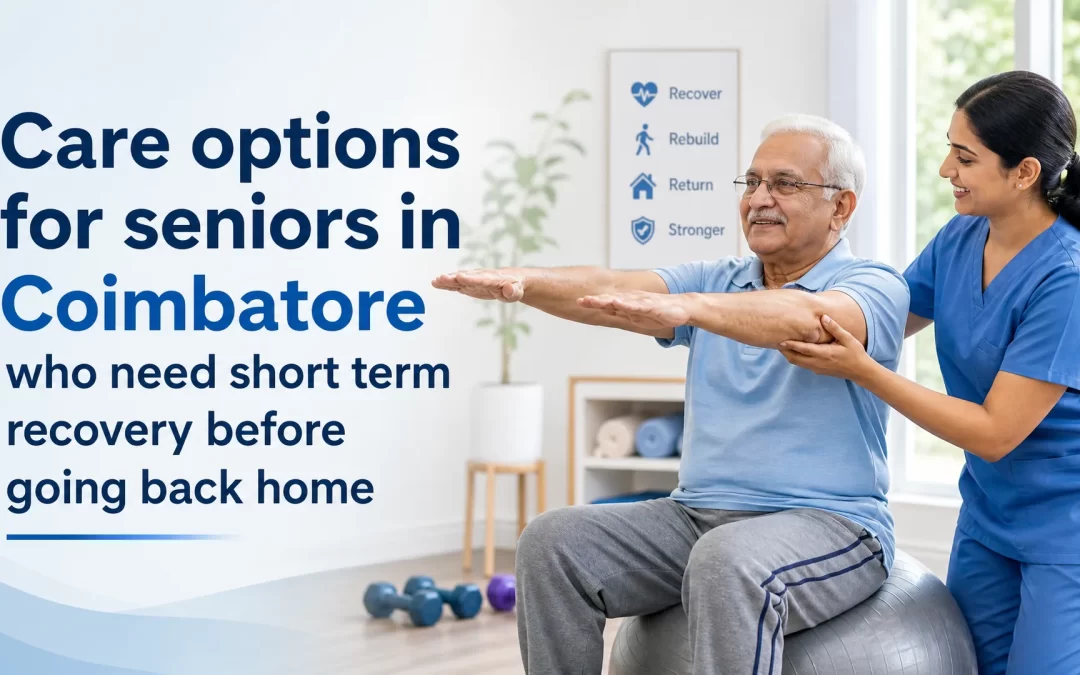
When a senior parent in Coimbatore is discharged after surgery or a serious illness, the family faces an immediate question: where should recovery happen? The hospital stay is over, but going straight home can feel risky. Meals, medication timing, wound care, mobility exercises, and fall prevention all demand attention that most families cannot safely provide around the clock. Short term recovery care bridges this gap, and understanding the available options in a city like Coimbatore can help families make confident, informed decisions during a stressful window.
- What is short term recovery care? – It is time limited, structured support (typically two to eight weeks) that helps seniors regain strength and independence after hospitalization before returning home safely. It can include physiotherapy, medication management, wound care, and daily living assistance.
- Centre based or home based? – Centre based recovery suits seniors who need medical monitoring, equipment access, or a safe environment when the home is not yet ready. Home based recovery works well when the home can be adapted and a qualified care team visits or stays on site.
- What is step down care? – Step down care is an intermediate level of supervised support between hospital intensity and independent living. It is designed to reduce readmission risk by continuing medical oversight while gradually restoring the senior’s functional abilities.
- Why does Coimbatore matter for this decision? – Coimbatore has a growing network of senior care centres, rehabilitation providers, and home care services. Families here can compare options locally, but practical guidance on choosing between them remains scarce, making informed decision support essential.
- How does transition care reduce readmission? – Structured transition care, whether at a centre or at home, can help lower readmission rates by ensuring medication continuity, early detection of complications, supervised mobility recovery, and coordinated follow up with the treating hospital team.
When seniors need short term recovery
Not every hospital discharge leads to a smooth homecoming. Seniors recovering from joint replacements, cardiac procedures, fractures, or prolonged illness often face weeks of reduced mobility and heightened medical risk. During this period, unsupervised recovery at home can lead to falls, missed medications, or wound complications.
Short term recovery care addresses this vulnerable window. It is not long term residential care. Instead, it is a focused program, usually lasting two to eight weeks, that combines medical monitoring with rehabilitation. The goal is functional independence: helping the senior walk safely, manage medications, and handle daily activities before the family assumes full responsibility at home.
Families in Coimbatore frequently encounter this need after orthopaedic surgeries at the city’s major hospitals or after acute episodes requiring ICU stays. The decision is rarely about whether recovery support is needed. It is about which format suits the senior’s medical condition, the home environment, and the family’s capacity.
Centre based recovery in Coimbatore
A centre based recovery option means the senior stays at a dedicated care facility for the duration of their short term rehabilitation. In Coimbatore, these facilities range from step down units attached to hospitals to standalone senior care centres that accept post discharge residents.
Who benefits most?
Centre based recovery is designed to help seniors who need round the clock nursing supervision, access to physiotherapy equipment, or a controlled environment that the home cannot provide. Seniors with complex wound care needs, those on multiple intravenous medications, or those whose homes have stairs and other fall hazards often recover more safely in a centre.
What to expect
A typical centre based program includes daily physiotherapy sessions, medication administration, vital sign monitoring, nutritional planning, and regular physician reviews. Some centres in Coimbatore also offer occupational therapy to help seniors relearn daily tasks like bathing and dressing before discharge home.
Families should ask about staff to patient ratios, visiting hours, discharge planning processes, and whether the centre coordinates with the senior’s treating hospital. A good centre will share progress reports and involve the family in goal setting from the start.
Rehab at home after discharge
Home based recovery is the other major pathway. Here, the senior returns home and a care team, which may include a nurse, physiotherapist, and trained caregiver, visits or stays at the residence to deliver structured rehabilitation.
When home recovery works
Home based rehab can help seniors who are medically stable but still need supervised exercises, wound care, or medication management. It works best when the home environment is reasonably safe: no steep staircases without railings, adequate bathroom support, and a clean space for the senior to rest and exercise.
In Coimbatore, several providers offer packaged home rehab programs that include physiotherapy visits, nursing check ins, and caregiver support. Families should confirm that the provider sends qualified professionals, not just attendants, and that a physician oversees the care plan remotely or through periodic visits.
Limitations to consider
Home recovery has constraints. If the senior needs oxygen support, complex wound management, or frequent lab monitoring, a home setup may not match the reliability of a centre. Families also need to assess their own availability. Even with professional support, someone at home usually needs to coordinate meals, manage emergencies, and communicate with the care team.
Step down care explained
Step down care is a term that confuses many families. In simple terms, it is the level of care that sits between hospital intensity and normal home life. A senior in step down care no longer needs ICU or acute ward resources but is not yet ready for unsupervised living.
Step down care can be delivered at a centre or at home, depending on the senior’s needs. The defining feature is structured medical oversight: regular vitals checks, medication reconciliation, and a rehabilitation schedule, all managed by a clinical team rather than family members alone.
For elderly patients in Coimbatore recovering from procedures like CABG, hip replacement, or a severe respiratory illness, step down care is designed to help reduce the risk of complications that lead to hospital readmission. It ensures that the transition from hospital to home is gradual and monitored.
Comparing the options
| Factor | Centre based recovery | Rehab at home | Step down care (centre or home) |
|---|---|---|---|
| Medical supervision | 24/7 nursing and physician access | Scheduled visits by nurse and physiotherapist | Structured clinical oversight, frequency depends on setting |
| Best suited for | Complex post surgical cases, fall risk, no safe home setup | Medically stable seniors with adaptable homes | Seniors between acute care and independence |
| Typical duration | 2 to 6 weeks | 2 to 8 weeks | 1 to 4 weeks |
| Family involvement | Visiting and goal setting | Daily coordination and emergency support | Varies by setting |
| Equipment access | On site physiotherapy and monitoring equipment | Portable equipment brought by therapist | Depends on whether centre or home based |
| Readmission risk management | Continuous monitoring can help catch complications early | Relies on scheduled check ins and family alertness | Designed specifically to bridge the readmission gap |
How to decide for your family
The right choice depends on three things: the senior’s medical complexity, the home environment, and the family’s caregiving capacity. There is no universal answer, but a few practical questions can guide the decision.
First, ask the treating physician whether the senior needs round the clock monitoring or whether scheduled visits are sufficient. Second, assess the home. Can the senior move safely from bed to bathroom? Is there space for a physiotherapist to work? Third, consider who will be available at home. If the primary caregiver works full time, centre based recovery may be more realistic for the initial weeks.
In Coimbatore, families also benefit from consulting with local senior care providers who can evaluate the home, recommend modifications, and propose a care plan that may combine centre and home phases. Some seniors start at a centre for the first two weeks and then transition to home based rehab once they regain basic mobility.
Choosing a provider in Coimbatore
Coimbatore’s healthcare ecosystem includes multi speciality hospitals, standalone rehabilitation centres, and home care agencies. When evaluating a provider for short term recovery, families should look for clinical credentials, transparent pricing, and a clear discharge plan.
Ask whether the provider employs qualified physiotherapists and nurses or outsources them. Confirm that a physician reviews the care plan at defined intervals. Request references from families who have used the service for similar recovery needs. A provider that coordinates with the discharging hospital, sharing medical records and aligning on medication protocols, is generally more reliable than one that operates in isolation.
Families should also clarify what happens if the senior’s condition worsens. Does the provider have an escalation protocol? Is there an arrangement with a nearby hospital for emergency transfers? These details matter more than brochure promises.
Short term recovery care is a practical, time bound investment in a senior’s safe return home. Whether the family in Coimbatore chooses a centre, home based rehab, or a step down program, the priority is the same: structured support that protects the senior during the most vulnerable weeks after discharge. Asking the right questions, evaluating the home environment honestly, and choosing a clinically supervised provider can make the difference between a smooth recovery and a preventable readmission.
FAQs
1. Which senior care option is best, home care or care centre?
It depends on the senior’s medical needs and the home environment. Centre based care suits complex cases needing round the clock monitoring. Home care works well for medically stable seniors with a safe home setup and family support available for coordination.
2. What is step down care for elderly patients?
Step down care is supervised, intermediate support between hospital discharge and independent living. It includes medication management, physiotherapy, and clinical monitoring to help seniors recover safely and can help reduce the risk of hospital readmission.
3. How does transition care reduce hospital readmission?
Transition care can help lower readmission risk by ensuring medication continuity, supervised rehabilitation, early detection of complications, and coordinated follow up with the hospital team during the vulnerable weeks after discharge.
4. How long does short term recovery care usually last for seniors?
Most short term recovery programs last two to eight weeks, depending on the surgery or illness, the senior’s progress, and the type of care setting chosen. Step down care phases tend to be shorter, typically one to four weeks.
5. Can post surgery rehabilitation for elderly patients be done at home?
Yes, home based post surgery rehabilitation is possible when the senior is medically stable, the home is safe and accessible, and qualified professionals such as physiotherapists and nurses deliver the care under physician oversight.


