
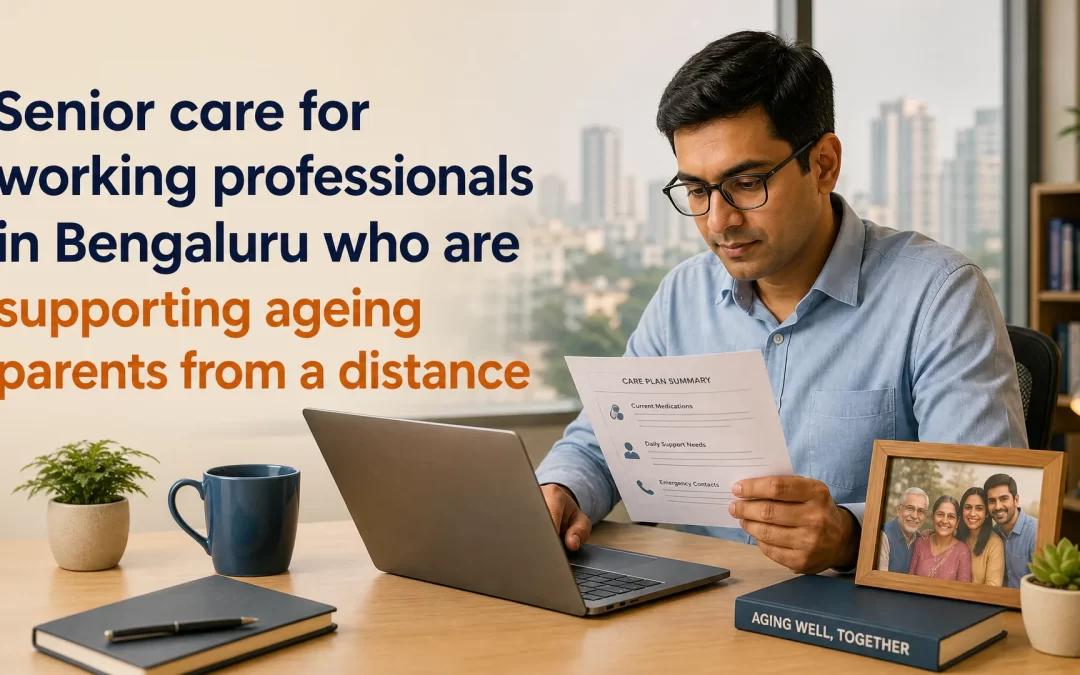
You built a career in Bengaluru. Your parents built a life somewhere else. Now, every missed call triggers a quiet dread. Is it a fall? A forgotten medication? A hospital visit no one told you about? For working professionals juggling demanding jobs and ageing parents, senior care is not an abstract concept. It is an urgent, daily negotiation between professional responsibility and filial duty. KITES Senior Care works with families exactly like yours, bridging the distance between Bengaluru offices and parents who need structured, compassionate support.
- Who is this guide for? – Working professionals in Bengaluru who manage senior care for ageing parents remotely, whether parents live in the same city or in another part of India. It addresses the specific anxieties, time constraints, and decision gaps this group faces.
- What senior care models exist? – Options range from home based elder care and geriatric home care to facility based care centres, step down care after hospitalization, and specialized services like dementia care or post surgery rehabilitation. The right model depends on your parent’s medical needs, mobility, and daily living requirements.
- How do I choose the right service? – Evaluate clinical supervision quality, caregiver training, communication protocols with remote families, and whether the provider offers a care continuum (from preventive medical care through palliative care) rather than isolated services.
- Why does Bengaluru specific context matter? – Bengaluru’s working population skews young and mobile, meaning many adult children are first generation remote caregivers. Local providers like KITES Senior Care can help families navigate city specific logistics, hospital discharge coordination, and ongoing geriatric care in Bengaluru.
- What should I do first? – Start with a structured needs assessment covering medical history, daily living limitations, and emergency protocols. A provider that offers this assessment before recommending a care plan is more likely to deliver reliable, personalized senior care.
Why remote caregiving is harder than it looks
Distance does not just add miles. It adds uncertainty. When you live in Bengaluru and your parents live elsewhere, you lose the small signals that indicate decline. A slight limp. A refrigerator full of expired food. Confusion about which pills to take at night.
Even when parents live in Bengaluru too, a 90 minute commute and a 10 hour workday can make you functionally remote. You may visit on weekends, but weekdays are a blind spot. This is the reality for thousands of professionals in the city.
The emotional toll compounds the practical one. Guilt about not being present. Anxiety about hiring the wrong caregiver. Frustration when parents resist help. These are not edge cases. They are the norm for working adults managing elder care from a distance.
Senior care models that fit your situation
Not every family needs the same solution. The right senior care model depends on your parent’s health status, cognitive function, mobility, and how much daily assistance they require. Here is a practical breakdown.
| Care model | Best suited for | What it typically includes |
|---|---|---|
| Senior home care | Parents who are mostly independent but need daily living assistance | Bathing assistance, medication management, meal support, companionship, mobility help |
| Geriatric home care | Seniors with multiple chronic conditions needing clinical oversight | Medical monitoring at home, skilled nursing, geriatric physiotherapy, polypharmacy management |
| Post surgery rehabilitation | Elderly patients recovering from knee replacement, CABG, or hip surgery | Structured rehab programs, physiotherapy after surgery, mobility recovery, readmission prevention |
| Step down care | Seniors transitioning from hospital to home who still need medical supervision | Recovery monitoring after discharge, medication transition support, discharge planning |
| Dementia or memory care | Parents with cognitive decline, Alzheimer’s, or wandering behavior | Safe environment, cognitive stimulation activities, behavioral management, caregiver respite |
| Assisted care | Seniors needing help with activities of daily living but not full nursing | Dressing assistance, hygiene support, medication reminders, comfort and supervision |
| Palliative or hospice care | Seniors with serious or terminal illness where comfort is the priority | Pain and symptom management, counselling support for families, dignity in end of life care |
KITES Senior Care is designed to help families navigate this spectrum. Rather than offering a single service in isolation, a care continuum approach means your parent can move from post hospitalization rehabilitation to ongoing geriatric care without switching providers.
How to choose the right provider
Bengaluru has no shortage of elder care listings. The challenge is distinguishing a dependable care partner from a staffing agency that sends a different attendant every week. Here is what to evaluate.
Clinical supervision matters more than headcount. Ask whether a geriatric medicine specialist oversees care plans, or whether decisions rest entirely with general caregivers. For parents with conditions like diabetes, hypertension, or early dementia, medical supervision for elderly patients is not optional.
Communication protocols are critical for remote families. You need a provider that sends structured updates, not just a WhatsApp message when something goes wrong. Ask how often you will receive health reports, who your point of contact is, and what the escalation process looks like for emergencies.
Continuity of care reduces risk. When your parent sees the same care team consistently, that team notices subtle changes in cognition, appetite, or mobility. High caregiver turnover is a red flag.
Finally, ask about the care assessment process. A provider that recommends a package before understanding your parent’s medical history, daily limitations, and home environment is selling a product, not delivering care. KITES Senior Care can help families start with a structured needs assessment that shapes the care plan around the individual, not around a menu.
What Bengaluru families face specifically
Bengaluru’s demographics create a particular caregiving pattern. The city attracts young professionals from across India. Many are first generation remote caregivers, meaning they have no family precedent for arranging professional senior care.
Hospital discharge is a common trigger point. A parent is admitted for a fall or a cardiac event. The hospital stay ends, but recovery does not. Families scramble to arrange post hospital care at home, often without knowing what transition care or post hospitalization rehabilitation involves.
Traffic and geography add friction. A parent in Jayanagar and an adult child in Whitefield may be 25 kilometers apart, but 90 minutes away during peak hours. This makes daily check ins impractical and reinforces the need for a reliable in home senior care setup.
Cost anxiety is real but often misplaced. Many families assume professional geriatric care services are unaffordable and instead rely on untrained domestic help. The hidden cost of that choice, missed medications, preventable falls, emergency hospitalizations, often exceeds the cost of structured senior home care services.
Building a remote caregiving system
You cannot be physically present every day. But you can build a system that compensates for distance. Here is a practical framework.
Start with a medical baseline. Compile your parent’s diagnoses, current medications, allergies, and recent hospital records into a single document. Share it with the care provider and keep a copy accessible on your phone.
Establish a communication rhythm. Weekly video calls with your parent and monthly check ins with the care team create accountability without micromanagement. Ask the provider for written health summaries at a frequency that matches your parent’s acuity level.
Plan for escalation, not just routine. Know which hospital your parent should go to in an emergency. Confirm that the care provider has a protocol for after hours situations. Identify a local family member or trusted neighbor who can be a physical first responder when you cannot.
Review and adjust quarterly. Senior care needs change. A parent who needed only assisted care six months ago may now require geriatric physiotherapy or medication management support. Build in regular reassessments rather than waiting for a crisis to force a change.
When to consider a care centre
Home care is not always the answer. Some situations call for a care centre or specialized facility. Recognizing that threshold is important.
If your parent has advanced dementia with wandering behavior, a secure dementia care centre with cognitive stimulation activities and 24 hour supervision may be safer than home care. If post surgery rehabilitation requires equipment and intensity that a home setup cannot support, a rehabilitation care center may accelerate recovery.
The decision is not a failure. It is a clinical judgment. KITES Senior Care can help families evaluate whether home based elder care or a care centre is more appropriate for their parent’s current condition, and can support transitions between the two as needs evolve.
For working professionals in Bengaluru, the goal is not to do everything yourself. It is to build a care system around your parent that is medically sound, emotionally supportive, and operationally sustainable from a distance. Start with an honest assessment of what your parent needs today, choose a provider that communicates transparently, and revisit the plan as circumstances change. That is not a compromise. That is responsible caregiving.
FAQs
1. How do I choose the right senior care service for my parents?
Start with a structured needs assessment covering medical conditions, daily living limitations, and cognitive status. Evaluate providers on clinical supervision, caregiver continuity, and communication protocols for remote families. KITES Senior Care can help with an individualized assessment before recommending a care plan.
2. Who provides senior care in Bengaluru?
Bengaluru has several senior care providers ranging from staffing agencies to integrated care organizations. KITES Senior Care offers a care continuum approach in Bengaluru, covering geriatric home care, post surgery rehabilitation, dementia care, assisted care, and transition care under clinical supervision.
3. Can senior home care help after surgery for elderly parents?
Yes. Post surgery rehabilitation at home can include geriatric physiotherapy, medication management, wound monitoring, and mobility recovery support. For surgeries like knee replacement or CABG, structured rehab programs can help reduce readmission risk and support faster functional recovery.
4. What is the difference between geriatric care and regular home nursing?
Geriatric care is specialized for age related conditions and typically involves oversight by a geriatric medicine specialist. Regular home nursing may focus on basic tasks without addressing polypharmacy management, cognitive decline, or multidisciplinary care planning that seniors with multiple conditions require.
5. When should I consider a care centre instead of home care?
Consider a care centre when your parent needs 24 hour medical supervision, has advanced dementia with safety risks at home, or requires intensive post hospitalization rehabilitation with specialized equipment. A provider like KITES Senior Care can help evaluate the right setting based on clinical needs.


