
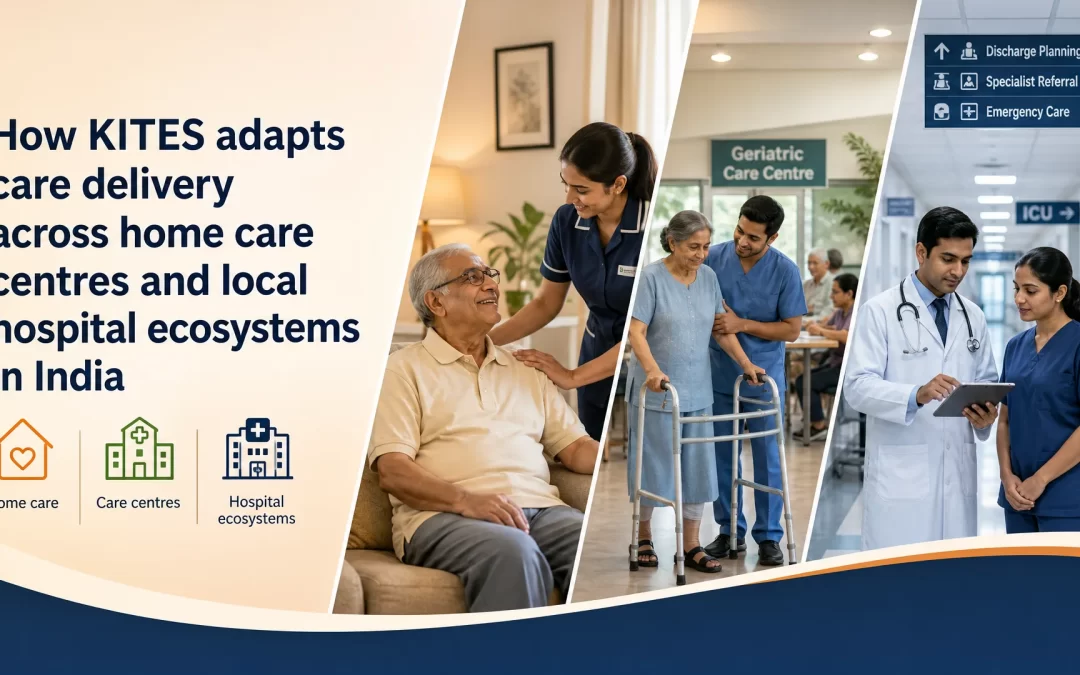
When a senior parent leaves a hospital bed in Bengaluru or Chennai, the family faces a question that rarely has a simple answer. Where does recovery actually happen? KITES approaches this challenge by adapting geriatric care across three distinct settings: the family home, dedicated care centres, and the local hospital ecosystem that surrounds both. Understanding how clinical coordination works across these settings can help families make safer, faster decisions about out of hospital care for seniors in India.
- What is out of hospital care for seniors? – Out of hospital care refers to clinically supervised services delivered after discharge, including transition care, rehabilitation, palliative support, and dementia management. KITES coordinates these services across homes, care centres, and local hospital networks so seniors recover without gaps in medical oversight.
- Why does the care setting matter? – Each setting serves a different clinical need. Home care suits stable seniors needing daily support. Care centres offer structured rehab or memory care. Hospital ecosystem ties ensure rapid escalation when a patient’s condition changes. KITES adapts protocols to each.
- How does KITES integrate local hospitals? – KITES maintains working relationships with local hospital teams for discharge planning, specialist referrals, and emergency re-admission pathways. This integration is designed to reduce readmission risk and speed up clinical decisions for families.
- Who benefits most from cross setting care? – Seniors recovering from surgery, those living with dementia or Alzheimer’s, and patients needing palliative or step down care benefit most. Families managing complex conditions across Indian cities gain continuity that single setting providers often cannot offer.
What out of hospital care means
Out of hospital care for seniors covers every clinical and supportive service delivered once a patient leaves the hospital. This includes transition care after discharge, post surgery rehabilitation, palliative care, dementia care, and assisted daily living support.
In India, families often assume that discharge means recovery is complete. That assumption creates risk. Seniors with multiple conditions need structured monitoring, medication management, and physiotherapy that hospitals no longer provide once the bed is vacated.
KITES frames out of hospital care as a coordinated continuum rather than a single service. The goal is to match the right intensity of care to the right setting, whether that is the patient’s home, a geriatric care centre, or a step down facility connected to a local hospital.
How care changes by setting
Home based geriatric care
Home care works best for seniors who are medically stable but need daily support. This includes medication management, geriatric physiotherapy, wound care after surgery, and assistance with bathing, dressing, and mobility.
KITES delivers home based elder care with clinical oversight. A care plan is built around the senior’s discharge summary, and a trained caregiver or nurse follows protocols that connect back to the supervising medical team. Families in cities like Bengaluru, Hyderabad, and Kolkata can access this model without relocating their parent.
Care centre support
Some conditions demand more structure than a home can provide. Post surgery rehabilitation after knee replacement or CABG, advanced dementia with wandering risk, and palliative care requiring round the clock symptom management are examples.
KITES care centres offer skilled nursing, structured rehab programs, memory care environments, and day care for dementia. These centres are designed to handle escalation internally, with medical supervision that a home caregiver alone cannot replicate.
Local hospital ecosystem ties
Neither home care nor a care centre operates in isolation. KITES integrates with local hospital ecosystems to maintain clinical continuity. This means discharge planning coordination, specialist referral pathways, diagnostic access, and emergency re-admission routes.
When a senior recovering at home shows signs of infection or a care centre patient needs imaging, the response depends on pre-established relationships with nearby hospitals. KITES builds these connections city by city, so escalation does not start from scratch each time.
Why integration reduces readmission
Hospital readmission among seniors is often preventable. Missed medication doses, delayed physiotherapy, and poor wound monitoring are common triggers. When care is fragmented across unconnected providers, these gaps widen.
KITES addresses this by ensuring that the home caregiver, the care centre team, and the referring hospital share a common care plan. Transition care protocols include medication reconciliation, recovery milestone tracking, and clear escalation criteria. This layered approach is designed to help reduce the chance that a senior returns to the emergency department unnecessarily.
Families benefit because they do not need to coordinate between three separate systems. A single provider that understands all three settings can move a patient from hospital to home, or from home to a care centre, without losing clinical context.
Choosing the right setting
The decision between home care and a care centre depends on clinical complexity, family capacity, and the senior’s own preferences. A few practical considerations can guide families.
If the senior is stable, oriented, and has a family member available part of the day, home based geriatric care with visiting nursing and physiotherapy may be sufficient. If the senior has advanced Alzheimer’s, needs post hospitalization rehabilitation with daily therapy sessions, or requires palliative pain management, a care centre with skilled nursing can help deliver safer outcomes.
KITES helps families evaluate these factors during the discharge planning phase. The recommendation accounts for the local hospital network available in the senior’s city, the type of recovery or ongoing care needed, and the family’s ability to participate in daily caregiving.
Families across India face different realities. A working professional in Chennai managing a parent’s recovery after surgery has different constraints than a retired spouse in Coimbatore supporting a partner with dementia. KITES adapts its model to both, because geriatric care services must flex to the patient’s life, not the other way around.
When families understand how out of hospital care connects homes, centres, and hospitals into a single coordinated system, they can make decisions with greater confidence. KITES offers this ecosystem fluency as a core part of its senior care services in India, giving families a provider that works across settings rather than within just one.
FAQs
1. What is out of hospital care for seniors?
Out of hospital care includes all clinical and supportive services delivered after a senior leaves the hospital. This covers transition care, rehabilitation, palliative support, dementia care, and daily living assistance, coordinated across home, centre, or community settings.
2. Which senior care option is best, home care or care centre?
The best option depends on clinical complexity and family capacity. Stable seniors often do well with home care. Those needing structured rehab, memory care, or round the clock nursing can benefit more from a care centre with skilled supervision.
3. How does KITES coordinate care across settings in India?
KITES builds relationships with local hospital teams in each city for discharge planning, specialist referrals, and emergency pathways. This integration connects home caregivers and care centre staff to a shared care plan, helping reduce gaps during recovery.
4. What is transition care for elderly patients after discharge?
Transition care bridges the gap between hospital and home or a care centre. It typically includes medication reconciliation, recovery monitoring, physiotherapy, and escalation protocols designed to help prevent avoidable hospital readmission for seniors.


