
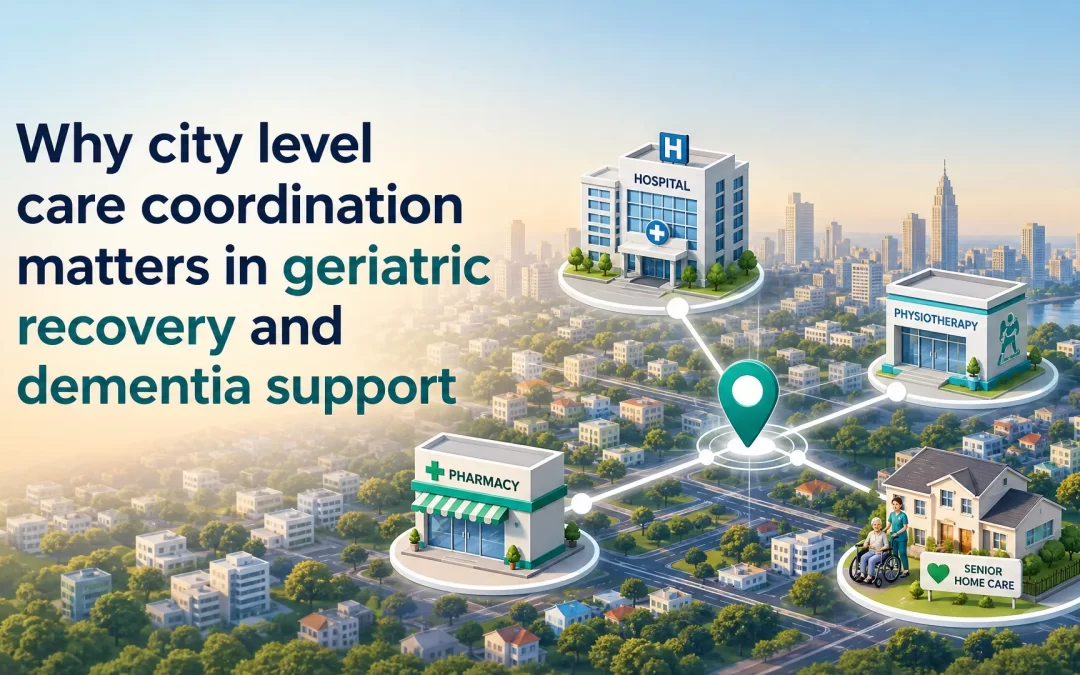
When a parent is discharged after hip surgery in Bengaluru or begins showing signs of cognitive decline in Hyderabad, families scramble for caregivers and facilities. What they rarely evaluate is whether the city’s medical ecosystem can coordinate around their senior. KITES Senior Care approaches this differently, recognizing that geriatric recovery and dementia support succeed or fail based on how well local services connect, not just on who shows up at the bedside.
- What is city level care coordination? – It is the structured linking of hospitals, therapists, pharmacies, diagnostics, and caregivers within a specific city so that a senior’s recovery or dementia care plan executes without gaps. Without it, families bear the burden of stitching services together on their own.
- Why does geography shape outcomes? – Each Indian city has different referral networks, ambulance response corridors, specialist availability, and commute realities. A care plan designed without accounting for these local factors can break down at the first emergency or therapy appointment.
- How does coordination reduce readmission? – When discharge summaries reach the home care team promptly, medication transitions happen under clinical oversight, and physiotherapy begins on schedule, seniors are far less likely to return to the hospital within 30 days.
- What should families evaluate beyond price? – Families should ask whether a provider has established relationships with nearby hospitals, diagnostic labs, and specialist consultants, and whether the provider can manage emergency escalation within the city’s infrastructure.
What coordination actually means
Care coordination is not a vague promise. It is the operational ability to move clinical information, therapy schedules, and emergency responses across multiple providers in a single city without the family acting as the go between.
In geriatric recovery, this means the orthopaedic surgeon’s discharge notes reach the home physiotherapist before the first session. In dementia support, it means the neurologist’s medication adjustments are communicated to the caregiver team the same day.
KITES Senior Care builds these connections city by city, establishing referral pathways with hospitals, diagnostic centres, and specialist clinics in Bengaluru, Hyderabad, Chennai, and other metros. This is what separates structured coordination from ad hoc caregiving.
Why city specifics change outcomes
Consider two families managing post surgery rehabilitation. One lives near a tertiary hospital in Bengaluru with a geriatric physiotherapy unit ten minutes away. The other lives in a part of Hyderabad where the nearest rehab specialist requires a 45 minute commute through congested traffic.
The care plan might be identical on paper. The outcomes will differ because geography dictates execution. Ambulance response corridors, pharmacy networks for specialized medications, and even the availability of home visit slots from trained geriatric nurses vary block by block.
Dementia care amplifies this further. A senior with Alzheimer’s who wanders needs a care environment connected to local emergency services and familiar with nearby safe zones. A dementia day care centre in Chennai that coordinates with the family’s neurologist and local pharmacy can help manage behavioural episodes far more effectively than an isolated facility.
Hospital handoffs are the weak link
The most dangerous moment in a senior’s care journey is the transition from hospital to home. Discharge summaries are often incomplete. Medication lists conflict with what the family has at home. Follow up appointments are scheduled without checking whether the senior can physically reach the clinic.
City level coordination addresses this by ensuring the transition care team receives clinical information before the patient leaves the hospital. KITES Senior Care’s approach to step down care and transition care is designed to bridge this gap, connecting hospital discharge planners with the home care team so nothing falls through.
This is especially critical in cities like Bengaluru and Hyderabad, where families may live far from the hospital that performed the surgery. Without a coordinated handoff, the burden of managing medications, wound care, and therapy scheduling falls entirely on family members who may lack clinical training.
Dementia needs a local safety net
Dementia care is not a single service. It is a web of cognitive stimulation, medication management, behavioural support, caregiver respite, and emergency response. Each thread must connect to local resources.
A memory care centre in Bengaluru that coordinates with nearby diagnostic labs for routine blood work, with a neurologist for quarterly reviews, and with a geriatric physiotherapy provider for mobility maintenance creates a safety net that isolated home care cannot replicate.
Families choosing a dementia care centre for seniors should ask specific questions. Does the centre have a referral relationship with a nearby hospital? Can it escalate a medical emergency within minutes, not hours? Does it coordinate medication changes with the prescribing neurologist directly?
These are the questions that reveal whether a provider operates within the city’s care ecosystem or merely occupies a building in it.
What families should evaluate
Price and caregiver ratios are visible. Coordination quality is not. Families can uncover it by asking pointed questions during provider evaluation.
First, ask which hospitals the provider has discharge coordination agreements with. A provider that receives patients from multiple hospitals in the city likely has established information sharing protocols.
Second, ask how therapy schedules are managed. Does the provider employ or contract with geriatric physiotherapists who can visit the home or centre on a predictable schedule, or does the family need to arrange therapy independently?
Third, ask about emergency pathways. In a city like Chennai, where traffic can delay ambulance response, does the provider have a protocol for stabilizing the patient and communicating with the nearest emergency department before transport?
KITES Senior Care is designed to answer these questions with specific, city level detail, because the team builds its service model around local medical ecosystems rather than applying a generic template across geographies.
Families evaluating dementia care services, transition care, or post hospitalization rehabilitation should treat coordination depth as a primary selection criterion, not an afterthought. The best care plan in the world fails if the city’s infrastructure cannot support its execution. Providers like KITES Senior Care that invest in local referral networks, hospital partnerships, and therapist access can help deliver outcomes that isolated caregiving arrangements struggle to match.
FAQs
1. How to choose a dementia care centre for seniors?
Evaluate whether the centre coordinates with local neurologists, diagnostic labs, and hospitals. Ask about emergency escalation protocols, caregiver training in behavioural management, and whether medication changes are communicated directly with the prescribing physician.
2. What are the best dementia care centres in Bengaluru?
The best centres in Bengaluru maintain referral relationships with nearby hospitals and specialist clinics. KITES Senior Care builds city specific coordination networks that can help connect dementia patients with local neurologists, physiotherapists, and emergency services.
3. Why does city level coordination matter for geriatric recovery?
Each city has different hospital networks, therapist availability, and commute realities. A recovery plan that accounts for these local factors is more likely to prevent readmission and maintain therapy schedules than a generic care plan applied without geographic context.
4. What should transition care include after hospital discharge?
Effective transition care should include timely transfer of discharge summaries, medication reconciliation, scheduled physiotherapy, and a clear emergency escalation pathway within the city. Providers like KITES Senior Care coordinate these elements across local medical ecosystems.


