
Healing Beyond Hospital Walls
For most families, hospital discharge brings relief – and uncertainty. After surgery, stroke, or prolonged illness, seniors often return home weaker, anxious, and at risk for complications. The truth is, recovery doesn’t end at discharge – it begins there.
At KITES Senior Care, we call this the “transitional window” -the crucial 2–8 weeks after hospitalisation when close medical supervision helps prevent setbacks and supports stable recovery.
This blog explores the best practices, recovery metrics, and clinical protocols that define effective post-hospitalization care for elderly adults – combining medical structure with compassionate, human understanding.
Understanding Post-Hospitaliszation Care for Seniors
Post-hospitaliszation care, also called transitional or step-down care, is a structured medical support program designed to help seniors recover safely after being discharged from a hospital. It bridges the gap between hospital-level treatment and managing at home independently.
Why It Matters:
- 1 in 3 seniors experience hospital readmission within 90 days due to inadequate post-discharge care.
- Common causes: infections, medication mismanagement, falls, or improper wound healing.
- With structured protocols, these risks can drop by over 40%, improving both survival and quality of life.
The Four Phases of Post-Hospital Recovery for Seniors
- Stabiliszation (Days 1-7): Medical monitoring and infection control.
- Rehabilitation (Weeks 2-6): Physiotherapy, nutrition, and wound care.
- Reconditioning (Weeks 4-8): Mobility training, cognitive exercises, and gradual independence.
- Maintenance (Months 2-6): Long-term medical check-ins, therapy continuation, and caregiver education.
Each phase requires careful coordination between physicians, therapists, nurses, and families – a system that KITES Senior Care has perfected through integrated facility and home-based recovery models.
Why the First 48 Hours Matter
In geriatric medicine, the first two days post-discharge are the “stabiliszation window.” During this time, seniors are most vulnerable to:
- Infections: especially at surgical or catheter sites
- Medication errors: confusion about doses or missed medications
- Dehydration: due to fatigue and loss of appetite
- Falls: because of weakness or unsteady gait
That’s why at KITES Senior Care, every discharge transition begins with a 6-Star Post-Hospital Assessment – a doctor-led evaluation covering vitals, wounds, medication reconciliation, nutrition, and mobility capacity.
Families often ask: “What should we look out for?” Here’s the checklist our medical team shares:
- Temperature or pain spikes
- Shortness of breath or irregular heartbeat
- Changes in urine output
- Changes in alertness, behaviour, or responsiveness
- Any new swelling, redness, or confusion
Early detection is prevention. Careful, proactive monitoring makes a big difference in an older adult’s recovery.
Rebuilding the Body: The Role of Rehabilitation
Recovery is a slow science – and it starts with movement. Even 48 hours of bed rest can cause seniors to lose up to 5% of muscle strength, especially in the lower limbs. That’s why physiotherapy isn’t optional – it’s therapeutic.
At KITES, rehab begins with a graded physiotherapy protocol:
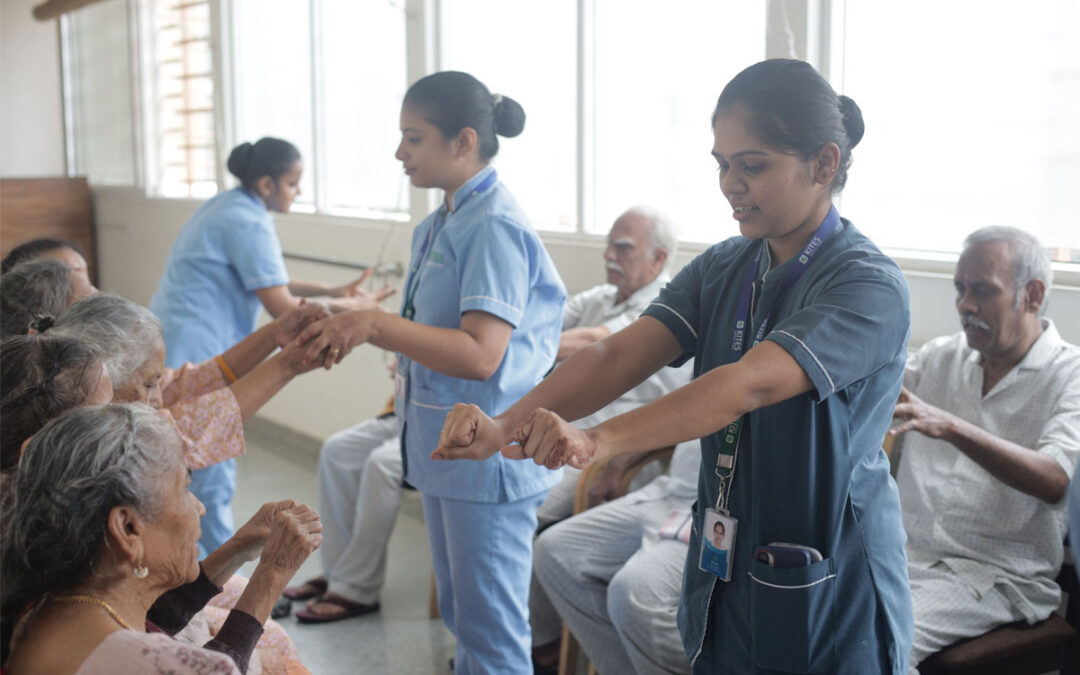
- Passive Exercises (Days 1-3): gentle limb movements to maintain circulation.
- Assisted Mobility (Days 4-10): walking with a gait belt or walker under supervision.
- Active Rehabilitation (Weeks 2-4): strength training, balance retraining, and endurance building.
Medical Equipment in Use:
- Walker or Rollator: improves stability while preventing falls.
- Pulse Oximeter: monitors oxygen levels during exertion.
- Incentive Spirometer: retrains lung function post-surgery or infection.
- Physioball or Resistance Bands: aids balance and limb toning
Relearning Independence
Post-hospitaliszation isn’t just physical; it also requires psychological reconditioning. Many seniors return home fearful – of falling, forgetting, or “being a burden.” The body heals slower when the mind feels unsafe.
Occupational Therapy and Routine Rebuilding
Relearning everyday activities like dressing, grooming, or safe transfers (bed → chair → toilet) helps retrain coordination and balance. Therapists often introduce energy conservation techniques – teaching seniors how to move safely without getting exhausted. The home itself becomes part of therapy: grab bars near bathrooms, non-slip mats in showers, wider walkways, and soft lighting to prevent disorientation. Adaptive aids such as raised toilet seats, grip utensils, and reachers preserve dignity and autonomy – small changes that make a big emotional impact.
Emotional Rehabilitation
Recovery is also about connection. Gentle social interaction, shared meals, and cognitive stimulation through puzzles, music, or guided reading keep the mind active. Family reassurance matters deeply – involving seniors in daily choices like mealtimes or hobbies nurtures purpose. Counselling and palliative care for post-ICU anxiety or trauma completes the process, helping seniors move from dependence to quiet confidence – a journey KITES Senior Care guides with empathy, structure, and steady medical oversight.
At KITES Senior Care, this integration of mind and body therapy is deliberate – because the most successful recoveries are holistic, not hurried.
Monitoring Recovery: Metrics That Matter
Clinical recovery can’t rely on intuition – it must be measured. Our geriatricians use Recovery Metrics Frameworks that translate progress into tangible indicators:
| Parameter | Target Benchmark | Why It Matters |
| Heart Rate | 60–90 bpm (resting) | Indicates cardiac stability |
| Oxygen Saturation | ≥94% on room air | Reflects respiratory recovery |
| Blood Pressure | <140/90 mmHg | Reduces stroke or cardiac risk |
| Muscle Strength | 20m walking tolerance | Sign of functional independence |
| Sleep Pattern | 6–8 hours uninterrupted | Marker of neurological normaliszation |
| Nutritional Intake | 80–100% of prescribed diet | Supports tissue repair |
Progress is reviewed weekly with family members;. iIf metrics plateau, therapy intensity or nutrition plans are adjusted immediately. This data-driven approach transforms care from reactive to predictive.
Medical Devices: The Right Trackers for Home Recovery
Families often underestimate how essential medical devices are in post-hospital care. When used correctly, they not only prevent complications but also foster independence.
Essential Devices and Their Roles:
- Digital BP Monitor: Detects fluctuations before symptoms appear; record readings twice daily, especially in post-cardiac or hypertensive seniors.
- Oxygen Concentrator: Supports respiratory recovery post-COVID or pneumonia; use with pulse oximeter tracking to ensure saturation stays above 94%.
- Anti-Decubitus Mattress: Prevents bedsores in bedridden seniors by promoting even pressure distribution – reposition every two hours for optimal effect.
- Suction Machine & Nebulizer: Manages airway clearance and medication delivery in post-ICU or stroke cases, maintaining lung hygiene.
- Urine and Bedside Commode Chairs: Maintains hygiene, reduces fall risk, and encourages safe night-time mobility under caregiver supervision.
At KITES Senior Care, each room – whether in-facility or at-home setup – is equipped with these tools, calibrated regularly, and operated by trained staff.
Preventing Readmission: The Golden Rule of Structured Recovery
Every doctor’s goal is not just recovery, but preventing a return to the hospital. Here’s how families can reduce the risk of readmission:
- Maintain a “medication map” – include dosage, timings, and possible side effects.
- Schedule follow-up consultations every 2-3 weeks during early recovery.
- Don’t rush mobility – prioritisze balance and stamina over speed.
- Ensure adequate home ventilation and hygiene, especially after respiratory illness.
- Watch for emotional fatigue in caregivers – burnout reduces quality of care.
In many seniors, readmissions stem from preventable causes – missed doses, unnoticed infections, or poor wound care. That’s why transitional care protocols matter. At KITES Senior Care, our transitional programmes emphasisze daily vital tracking, therapy continuity, and nutrition monitoring, ensuring that every small sign of regression is caught early. Each discharge plan includes a personaliszed home adaptation checklist, caregiver orientation, and ongoing nurse supervision, transforming recovery from a fragile phase into a sustainable process of health restoration and confidence.
How KITES Senior Care Redefines Post-Hospital Recovery
KITES isn’t just a care centre – it’s a continuum that supports seniors through every stage of recovery.. Our model blends hospital-grade medical systems with home-like comfort, ensuring that care feels familiar yet clinically sound.
What Makes Our Post-Hospital Program Different:
- Integrated Care Chain: From hospital discharge → rehab centre → homecare.
- Doctor-Led Ecosystem: Every plan is designed by a geriatrician and executed by a multidisciplinary team.
- 24×7 Medical Supervision: In-facility recovery wards with ICU backup and nursing oversight.
- Therapy Integration: Physiotherapy, speech, and occupational sessions under one roof.
- Family Partnership: Transparent communication, digital reports, and caregiver education.
Whether it’s a stroke survivor relearning movement or a post-surgery senior regaining strength, our goal remains constant – to rebuild life, not just health.
True recovery doesn’t end when a wound heals or the test results normalise. It ends when a senior feels safe enough to live fully again – to walk, eat, laugh, and rest without fear. Post-hospital care is that bridge – between illness and independence, between medical stability and emotional security.
At KITES Senior Care, we stand on that bridge with families every day.