
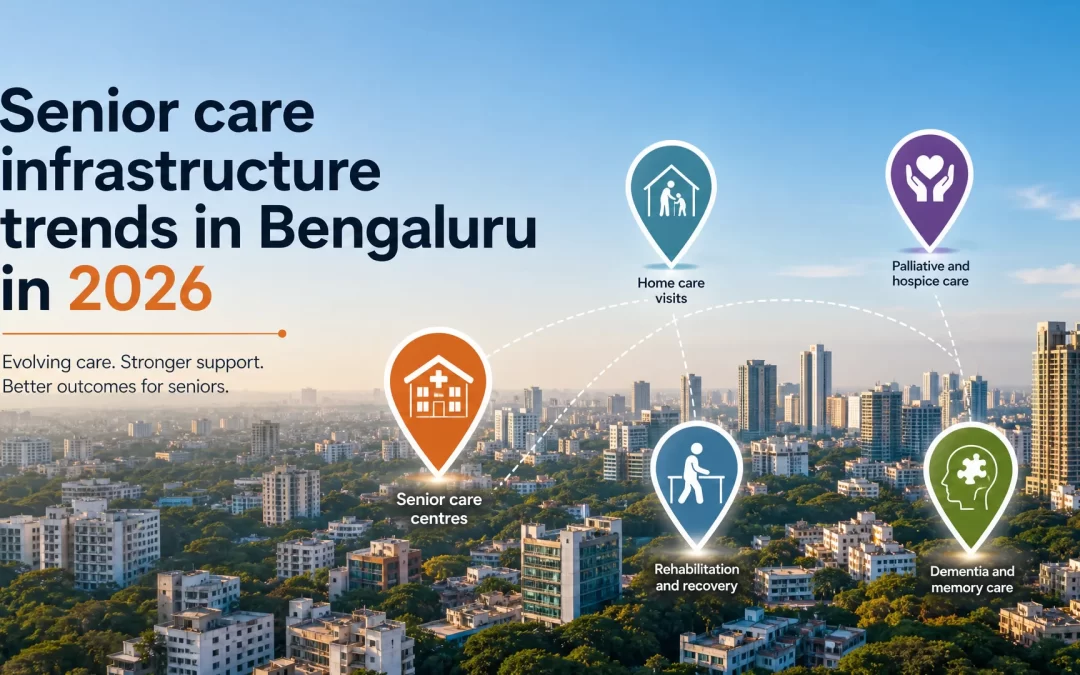
Bengaluru’s senior population is growing faster than its care infrastructure can keep pace with. Families searching for reliable geriatric care, post-surgery rehabilitation, dementia support, or palliative services in the city face a fragmented landscape. KITES, a specialized out of hospital care provider, operates within this ecosystem to bridge critical gaps between hospital discharge and long term recovery. Understanding how Bengaluru’s senior care infrastructure is evolving in 2026 can help families, referral partners, and care professionals make better decisions about where and how elderly residents receive support.
- Who provides senior care in Bengaluru? – Bengaluru’s senior care ecosystem in 2026 includes hospital linked step down units, standalone care centres, home care agencies, and specialized providers like KITES that offer out of hospital geriatric care spanning rehabilitation, dementia support, palliative services, and transition care.
- What infrastructure trends matter most? – Key trends include rising demand for home based elder care, expansion of dementia and memory care capacity, growth in post-surgery rehabilitation pathways, and stronger hospital to home transition programs designed to reduce readmission rates among seniors.
- Where do gaps remain? – Bengaluru still lacks sufficient specialized dementia day care centres, integrated palliative care networks, and standardized quality benchmarks across home care providers. Families often struggle to find credible, clinically supervised options outside of hospitals.
- How does KITES fit in? – KITES positions itself as a specialized out of hospital care provider in Bengaluru, offering geriatric home care, post-hospitalization rehabilitation, dementia care, palliative support, and assisted care services with clinical oversight tailored to seniors recovering outside hospital settings.
Bengaluru’s senior care landscape
Bengaluru is one of India’s strongest demand markets for professional elder care. The city’s demographic profile, with a large population of aging parents whose adult children work in technology and services sectors, creates consistent demand for structured senior care services.
In 2026, the city’s care infrastructure spans several categories. Hospital based geriatric departments handle acute episodes. Standalone care centres provide medium to long term residential support. Home care agencies deliver daily assistance, nursing, and rehabilitation at the patient’s residence. Specialized providers like KITES focus on out of hospital care, covering the clinical and functional recovery space that hospitals do not typically manage after discharge.
The referral ecosystem has also matured. Hospitals in Bengaluru increasingly partner with external rehabilitation and transition care providers to manage post-discharge recovery. This shift reflects a broader recognition that seniors recovering from surgery, stroke, or acute illness need structured support beyond what a hospital stay alone can deliver.
Key infrastructure trends
Several measurable shifts define Bengaluru’s senior care infrastructure in 2026. The table below summarizes the most significant trends, the service categories they affect, and the current state of capacity in the city.
| Trend | Service category affected | Current state in Bengaluru (2026) |
|---|---|---|
| Rising home care demand | Senior home care, geriatric home care | Demand is growing as families prefer recovery at home; supply of clinically supervised home care providers remains limited relative to need |
| Post-surgery rehabilitation expansion | Post-surgery rehab, step down care, transition care | More hospitals now refer to external rehab providers like KITES; dedicated rehab centres for seniors are still concentrated in select areas |
| Dementia and memory care growth | Dementia care, Alzheimer’s care, memory care, day care for dementia | A small number of specialized dementia care centres operate in the city; day care options for dementia remain scarce |
| Palliative and hospice care formalization | Palliative care, hospice care, end of life support | Home palliative care is expanding but lacks standardized protocols across providers; hospice care infrastructure is still nascent |
| Hospital to home transition programs | Transition care, out of hospital care, post-hospitalization rehabilitation | Structured discharge planning with external care partners is becoming more common; readmission prevention is a growing focus |
| Assisted and supportive care services | Assisted care, supportive care, daily living assistance | Growing number of providers offer personal care assistance; quality and clinical oversight vary widely |
| Geriatric physiotherapy access | Geriatric physiotherapy, mobility recovery | Home based physiotherapy for seniors is available but not always integrated into broader care plans |
Home care versus centre care
One of the defining questions for Bengaluru families in 2026 is whether to arrange senior care at home or in a dedicated care centre. Both models have expanded, but they serve different needs.
Home based elder care suits seniors who are medically stable but need daily assistance, medication management, physiotherapy, or post-hospitalization rehabilitation. Providers like KITES deliver geriatric home care with clinical supervision, covering skilled nursing, rehab care, and palliative support within the patient’s residence.
Centre based care is more appropriate for seniors who need round the clock medical monitoring, structured dementia care environments, or intensive rehabilitation that requires specialized equipment. Bengaluru has a limited but growing number of geriatric care centres and memory care facilities that cater to these needs.
The gap between these two models is where transition care and step down care become critical. Seniors discharged from hospitals often need a level of support that exceeds what a basic home caregiver can provide, but does not require readmission. KITES and similar providers fill this space with structured out of hospital care programs.
Dementia and memory care capacity
Dementia care is one of the most underserved segments of Bengaluru’s senior care infrastructure. While awareness of Alzheimer’s disease and related conditions has increased, the city’s capacity to provide specialized dementia care, memory care, and day care for dementia patients remains limited.
A small number of dedicated dementia care centres operate in Bengaluru. These facilities offer structured activities, cognitive stimulation, wandering prevention, and behavioral management in secure environments. However, most families still rely on home based dementia care, which can be effective when delivered by trained professionals but often lacks the structured programming that a specialized centre provides.
KITES offers dementia care services that include home based cognitive support, caregiver training, and coordination with geriatric specialists. For families managing Alzheimer’s care at home, this type of provider can help reduce safety risks and caregiver burnout without requiring a full residential placement.
Day care for dementia, a model that allows seniors to attend a supervised program during the day while returning home in the evening, is still rare in Bengaluru. This gap is significant because dementia day care can help reduce caregiver stress and provide social engagement for patients with cognitive decline.
Rehabilitation and recovery pathways
Post-surgery rehabilitation and post-hospitalization rehabilitation are among the fastest growing segments of Bengaluru’s senior care market. As surgical volumes for procedures like knee replacement, hip replacement, and CABG increase among older adults, the need for structured recovery support after discharge has grown proportionally.
In 2026, Bengaluru’s rehabilitation infrastructure for seniors includes hospital based outpatient rehab programs, standalone rehabilitation centres, and home based rehab services. KITES provides post-surgery rehabilitation and post-hospitalization rehabilitation at home, combining geriatric physiotherapy, medication management, and medical monitoring to support functional recovery.
The hospital to home transition is a critical vulnerability for seniors. Without structured transition care, elderly patients face higher readmission risk, medication errors, and delayed recovery. Providers that offer integrated step down care, combining clinical oversight with daily living assistance, can help address this gap.
Rehabilitation after surgery for seniors typically involves physiotherapy for mobility recovery, pain management, wound care coordination, and gradual return to independence. The duration varies by procedure and patient condition, but structured programs designed for elderly patients tend to produce better outcomes than unstructured rest at home.
Palliative and hospice care
Palliative care for seniors in Bengaluru is expanding, but the infrastructure remains uneven. Home palliative care is the most common model, with providers offering pain and symptom management, comfort care, counselling support for families, and coordination with treating physicians.
KITES provides palliative care at home for seniors in Bengaluru, focusing on quality of life, dignity, and family support for patients with serious or advanced illness. This service category is distinct from hospice care, which is specifically oriented toward end of life support when curative treatment is no longer the primary goal.
Hospice care infrastructure in Bengaluru is still nascent. Few dedicated hospice facilities exist, and most end of life care for seniors is delivered at home or in hospital settings. Families navigating this space often lack clear guidance on when to transition from active treatment to comfort focused care, making provider expertise and compassionate communication essential.
Gaps and opportunities
Despite meaningful progress, Bengaluru’s senior care infrastructure in 2026 still has notable gaps. Standardized quality benchmarks for home care providers are largely absent, making it difficult for families to compare options on clinical reliability. Dementia day care remains scarce. Integrated palliative care networks that connect hospitals, home care teams, and hospice services are still developing.
For families, the practical challenge is finding providers that combine clinical competence with compassionate, person centered care. KITES can help address this by offering a range of specialized services, from geriatric home care and post-surgery rehabilitation to dementia care and palliative support, within a single coordinated care model.
Referral partners, including hospitals, geriatricians, and discharge planners, also benefit from working with providers that can manage the full spectrum of out of hospital care. As Bengaluru’s senior population continues to grow, the providers that invest in clinical depth, caregiver quality, and service integration are best positioned to serve this market.
Bengaluru families evaluating senior care options in 2026 should prioritize providers with clear clinical supervision, specialized training for conditions like dementia and post-surgical recovery, and transparent communication about what each service includes. KITES is designed to meet these criteria as a specialized out of hospital care provider serving seniors across the city.
FAQs
1. Who provides senior care in Bengaluru?
Senior care in Bengaluru is provided by hospital geriatric departments, standalone care centres, home care agencies, and specialized out of hospital care providers like KITES. KITES offers geriatric home care, rehabilitation, dementia care, and palliative support for seniors across the city.
2. What are the best senior home care services in Bengaluru?
The best senior home care services in Bengaluru combine clinical supervision with daily living assistance, medication management, and rehabilitation. KITES is designed to deliver this level of integrated geriatric home care for seniors recovering at home after hospitalization or managing chronic conditions.
3. Who provides palliative care at home for seniors in Bengaluru?
Home palliative care for seniors in Bengaluru is offered by specialized providers including KITES, which focuses on pain and symptom management, comfort care, and family counselling support for elderly patients with serious illness, delivered within the patient’s residence.
4. What are the best dementia care centres in Bengaluru?
Bengaluru has a small number of specialized dementia care centres offering structured cognitive activities and secure environments. KITES provides home based dementia care and Alzheimer’s care services, which can help families who prefer managing cognitive decline support at home with professional guidance.
5. What are the best post-surgery rehabilitation centres for seniors in Bengaluru?
Post-surgery rehabilitation for seniors in Bengaluru is available through hospital outpatient programs, standalone rehab centres, and home based providers. KITES offers post-surgery rehabilitation at home, combining geriatric physiotherapy, medical monitoring, and step down care to support recovery after procedures like knee replacement or CABG.


