
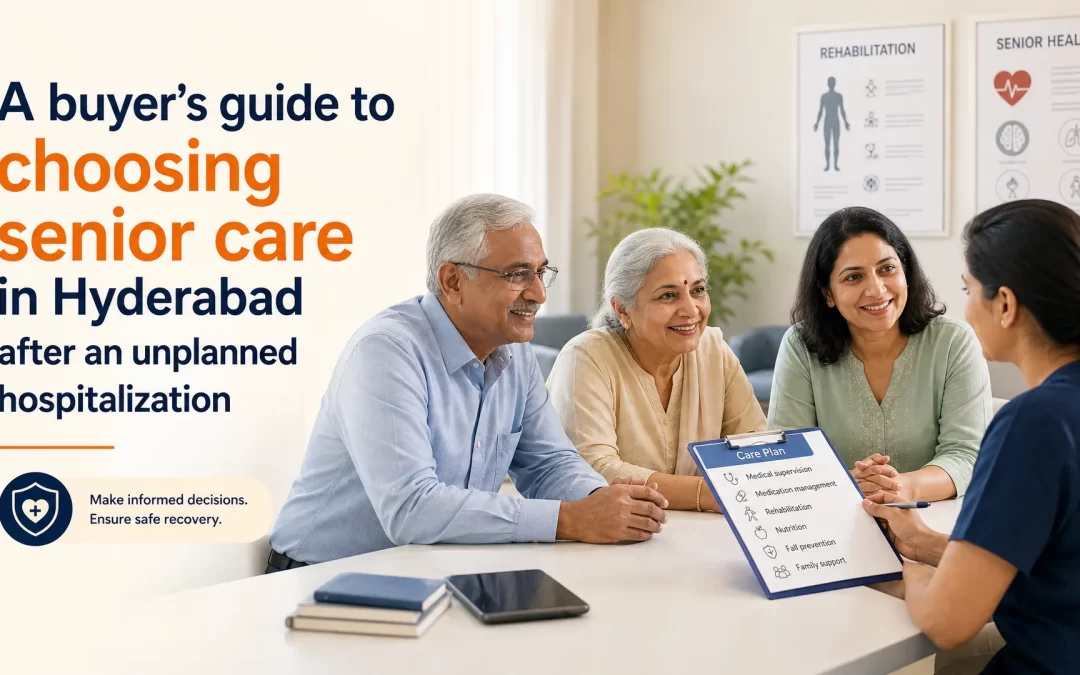
When a parent or grandparent is suddenly hospitalized in Hyderabad, the family faces a cascade of decisions within days. The hospital discharge team may hand over a summary, but the real challenge begins at home: managing medicines, preventing falls, monitoring vitals, and coordinating follow up visits. KITES Senior Care, a geriatric care specialist operating in Hyderabad since 2023, is designed to bridge exactly this gap through structured transition and rehabilitation care for seniors.
- What is transition care? – Transition care is structured, medically supervised recovery support that bridges the gap between hospital discharge and safe return home. It typically includes nursing oversight, medication management, physiotherapy, and readmission prevention monitoring. KITES Senior Care delivers this at its Banjara Hills centre and through home care programs in Hyderabad.
- Why does it matter after unplanned hospitalization? – Seniors aged 60 and above face hospitalization rates of 81 per 1,000 in India (NSO data, 2026). Without structured step down care, risks like medication errors, falls, dehydration, and missed warning signs can lead to avoidable readmission.
- What should families evaluate? – Focus on five criteria: clinical supervision depth, rehabilitation capability, care coordination protocol, cost transparency, and flexibility between centre based and home based delivery. A provider scoring well across all five is designed to reduce recovery risk.
- How does KITES compare? – KITES Senior Care offers a 6 star assessment process, a documented Care Management Protocol, and both centre based and home based delivery in Hyderabad. Its services span post hospitalization rehab, palliative care, dementia care, and geriatric home care under one brand.
Why discharge is a risk point
Hospital discharge after an unplanned event is one of the most vulnerable moments for a senior. The patient may still be weak, confused, or managing new medications. Family members, often working professionals, must suddenly coordinate nursing, physiotherapy, and follow up appointments.
NSO data published in 2026 shows that hospitalization rates among Indians aged 60 and above reach 81 per 1,000 annually. Chronic conditions such as diabetes, cardiac disease, and hypertension drive most of these admissions. The post discharge window, typically the first seven to fourteen days, carries the highest risk of complications and readmission.
In Hyderabad, families searching for post hospital support encounter a fragmented landscape. Home nursing agencies, standalone physiotherapy clinics, palliative care providers, and attendant services each cover a slice of the need. Few providers combine clinical supervision, rehabilitation, medication management, and family coordination under a single care plan.
What transition care includes
Transition care, sometimes called step down care, is a structured recovery program that sits between acute hospital treatment and routine home life. It is designed to help seniors regain independence while reducing the chance of readmission.
A comprehensive transition care program typically covers the following components.
Medical supervision and nursing
Round the clock or scheduled nursing visits, vital sign monitoring, wound care if needed, and escalation protocols for emergencies. The supervising physician reviews progress regularly and adjusts the care plan.
Rehabilitation
Physiotherapy, occupational therapy, and mobility training tailored to the specific surgery or illness. For example, knee replacement recovery requires guided walking and range of motion exercises, while post cardiac surgery (CABG) recovery focuses on breathing exercises and graded activity.
Medication management
Reconciling hospital prescriptions with existing medicines, ensuring correct dosage and timing, and watching for adverse reactions. This is especially important for seniors managing polypharmacy, where multiple prescriptions interact.
Family coordination
Keeping family members informed about progress, teaching basic caregiving skills, and planning the transition from professional care back to family supported daily life.
Five criteria for choosing a provider
When time is short and the stakes are high, families need a structured way to evaluate senior care providers in Hyderabad. The following five criteria form a practical scoring framework.
| Criteria | What to look for | Questions to ask the provider |
|---|---|---|
| Clinical supervision | In house or visiting physician, trained geriatric nurses, emergency escalation plan | Who supervises the care plan? How quickly can a doctor respond to a change in condition? |
| Rehabilitation capability | On site physiotherapy, occupational therapy, condition specific rehab protocols | Do you have rehab programs for my parent’s specific condition (e.g. post CABG, knee replacement, stroke)? |
| Care coordination | Single point of contact, documented care protocol, regular family updates | Will we have a dedicated care manager? How often will we receive progress updates? |
| Cost transparency | Clear pricing, itemized services, no hidden charges for essentials | Can you share a detailed cost breakdown before admission? Are medicines and diagnostics included? |
| Delivery flexibility | Centre based care, home based care, or a combination depending on the patient’s needs | Can care start at the centre and shift to home as recovery progresses? |
Score each criterion from zero (no evidence) to two (strong evidence). A provider scoring eight or above across all five areas is likely equipped for safe post hospital recovery. Providers scoring below five on this matrix may lack the clinical depth needed for transition care.
How KITES Senior Care fits
KITES Senior Care positions itself as an out of hospital care continuum partner for seniors and their families. Founded in 2016, KITES began operations in Hyderabad in 2023 and has supported over 1,000 seniors and families from its Centre for Advanced Geriatric Rehabilitation in Banjara Hills.
Against the five criteria above, KITES advertises the following capabilities.
| Criteria | KITES Senior Care capability |
|---|---|
| Clinical supervision | 24×7 medical supervision with in house doctor, skilled nursing care, and emergency response systems at the Banjara Hills centre |
| Rehabilitation capability | Specialized rehab technology, dedicated physiotherapy and activity spaces, condition specific programs for post CABG, knee replacement, stroke, hip replacement, and general deconditioning |
| Care coordination | KITES Care Management Protocol with a 6 star assessment process; Senior Care Managers work closely with families for long term care support |
| Cost transparency | Customizable care packages; families can choose specific services based on need |
| Delivery flexibility | Both centre based care at the Banjara Hills facility and home based geriatric care across Hyderabad |
Beyond transition care, KITES also provides palliative and hospice care, dementia and Alzheimer’s care, and preventive geriatric home care. This breadth means families do not need to switch providers if the senior’s needs evolve from short term recovery into longer term support.
Centre care versus home care
One of the first decisions families face is whether to bring the senior to a care centre or arrange professional care at home. Both options have trade offs.
Centre based care, such as the KITES facility in Banjara Hills, offers round the clock supervision, on site rehab equipment, structured daily routines, and immediate access to nursing staff. It is typically better suited for seniors who need intensive rehabilitation, have high fall risk, or require close medical monitoring in the first weeks after discharge.
Home based care works well when the senior is medically stable, the home environment is safe (no steep stairs, accessible bathroom), and a family member can provide supplementary support. KITES delivers home care through experienced professionals following the same Care Management Protocol used at its centres.
Many families start with centre based care for the first two to four weeks and then transition to home care as recovery progresses. Ask the provider whether this hybrid approach is available and how the handoff is managed.
Conditions that need transition care
Not every hospital discharge requires professional transition care. Families should consider it when the senior meets one or more of these conditions.
Post surgical recovery is a common trigger. Knee replacement, hip replacement, cardiac bypass (CABG), and spinal procedures all require structured rehabilitation to restore mobility and prevent complications. KITES Senior Care documents specific rehab programs for each of these conditions.
Stroke recovery demands early, intensive physiotherapy and occupational therapy. Delayed rehabilitation can reduce the chances of regaining lost function. A centre with dedicated rehab technology and trained therapists is designed to improve outcomes.
Prolonged hospitalization, even without surgery, can cause significant deconditioning. Seniors who spent more than a week in bed may struggle with balance, muscle weakness, and fatigue. Step down care with graded activity can help rebuild strength safely.
Seniors managing multiple chronic conditions (diabetes, hypertension, kidney disease) face higher readmission risk. Transition care with active medication management and vital sign monitoring can help close gaps that routine family care may miss.
Red flags during recovery
Families should watch for warning signs that indicate the current care arrangement is not working. These include persistent confusion or delirium, unexplained weight loss, new or worsening pain, missed medication doses, inability to perform basic activities like standing or walking to the bathroom, and signs of infection such as fever or wound redness.
If any of these appear, escalate to the supervising physician immediately. A good transition care provider will have a clear escalation protocol and emergency response plan in place.
Dementia and memory care
Some seniors are hospitalized for a medical event but also have underlying cognitive decline. Families may discover during the hospital stay that the senior has been managing early dementia symptoms without support.
In these cases, the post discharge plan must address both physical recovery and cognitive safety. KITES Senior Care offers a comprehensive Dementia Rehab Care Program in Hyderabad that includes supervised medical care, cognitive retraining, structured activities, and a secure environment designed to prevent wandering and reduce agitation.
If your parent shows confusion, memory lapses, or behavioral changes during or after hospitalization, ask the transition care provider whether they have specialized dementia care capabilities. Not all providers do.
A practical decision checklist
Use this checklist when evaluating any senior care provider in Hyderabad after an unplanned hospitalization. It consolidates the criteria and red flags discussed above into a single reference.
First, confirm clinical basics. Does the provider have a physician on call or on site? Is nursing care available around the clock or on a scheduled basis? What is the emergency escalation plan?
Second, assess rehabilitation fit. Does the provider offer condition specific rehab (not just general physiotherapy)? Are there dedicated therapy spaces and equipment? Can they share a sample rehab schedule?
Third, evaluate coordination. Will you have a single point of contact? How are progress updates shared? Is there a documented care protocol?
Fourth, clarify costs. Ask for an itemized breakdown. Confirm whether medicines, diagnostics, meals, and transport are included or billed separately.
Fifth, check flexibility. Can care start at a centre and move home? Can the provider scale services up or down as recovery progresses?
Families who work through these five areas systematically can make a faster, more confident decision, even under the pressure of an unplanned discharge.
Choosing senior care in Hyderabad after an unplanned hospitalization does not have to be overwhelming. Focus on clinical supervision, rehabilitation capability, care coordination, cost clarity, and delivery flexibility. KITES Senior Care, with its Banjara Hills centre and home care programs, is designed to address each of these criteria for families navigating urgent post hospital decisions. Reach out to a provider early, ideally before discharge, so the transition plan is ready when the senior leaves the hospital.
FAQs
1. What are the best transition care services in Hyderabad?
Transition care services in Hyderabad include providers like KITES Senior Care, which operates a Centre for Advanced Geriatric Rehabilitation in Banjara Hills. KITES offers post hospitalization rehab, nursing supervision, physiotherapy, and medication management for seniors recovering from surgery, stroke, or prolonged illness.
2. Can transition care be provided at home in Hyderabad?
Yes. Providers like KITES Senior Care deliver home based geriatric care across Hyderabad using the same clinical protocols as their centre based programs. Home care works best when the senior is medically stable and the home environment is safe for recovery.
3. How does transition care reduce hospital readmission for seniors?
Transition care can help reduce readmission by closing common post discharge gaps such as missed medicines, falls, delayed warning signs, and poor follow up. Active monitoring, structured rehabilitation, and a clear escalation plan are the key elements that lower risk.
4. What is step down care for elderly patients?
Step down care is a structured recovery program between hospital discharge and routine home life. It includes medical supervision, rehabilitation, medication management, and daily living support to help seniors regain independence safely after an acute event.
5. What should a post hospital care plan include for elderly parents?
A post hospital care plan for elderly parents should include physician supervised monitoring, condition specific physiotherapy, medication reconciliation, nutrition planning, fall prevention measures, and regular family updates from a dedicated care coordinator.


