
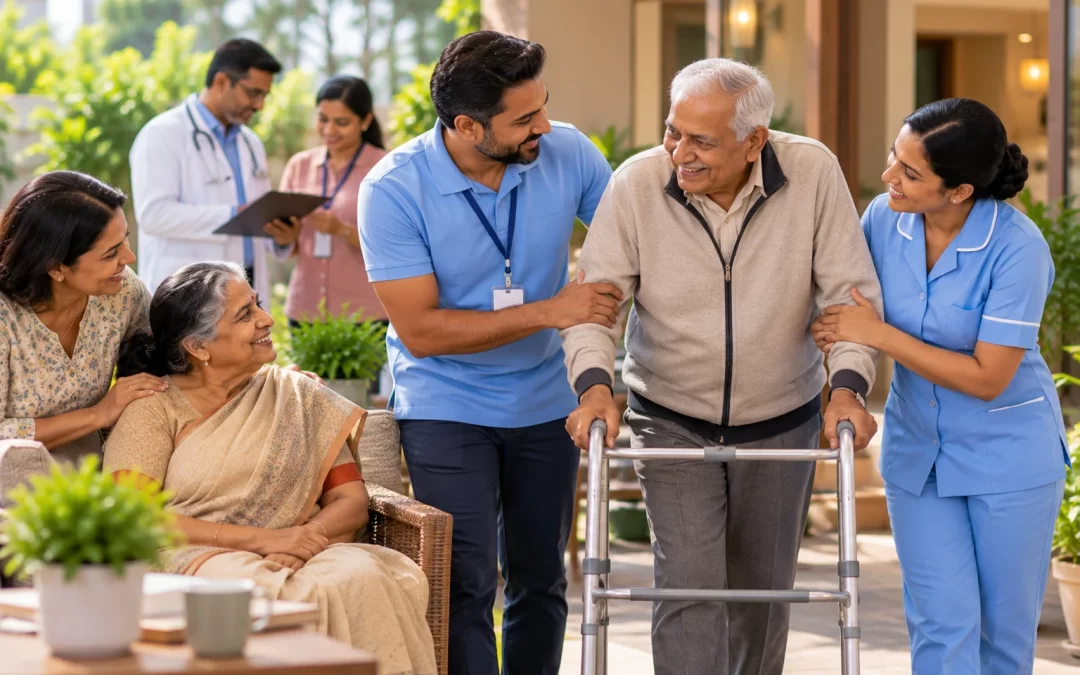
Choosing senior care for a parent in India often feels harder than it should. Families are usually forced to shop by episode, one provider for home support, another for rehabilitation, and another when dementia or palliative needs appear. KITES frames this problem differently: quality senior care works best when it is built around continuity across changing needs, not one time services bought in isolation.
- How should families choose? – The best starting point is not a single service label. Families should ask what support a parent needs now, what is likely to change next, and whether one provider can safely continue care across those transitions.
- Why continuity matters? – Older adults rarely stay in one fixed care category. A parent may move from post hospital recovery to assisted care, dementia support, or palliative care over time, so fragmented handoffs can create stress, repetition, and gaps.
- Home care or care centre? – Neither is automatically better. The right option depends on medical monitoring, mobility, safety, rehabilitation intensity, caregiver availability, and whether the same provider can coordinate care if needs change.
- What quality looks like? – Good senior care in India should combine assessment, care planning, communication, and service progression. KITES is built around this integrated approach rather than isolated service offers.
- What should families ask? – Ask whether the provider can manage transitions across rehab care, assisted care, dementia care, and palliative support without starting over each time. That question often reveals more than a price list.
What goes wrong now?
Most families do not plan elder care as a long term pathway. They respond to a fall, a surgery, a hospital discharge, wandering, weight loss, or caregiver burnout. In that moment, the market presents separate buckets such as senior home care, rehab care, dementia care, or hospice care. The family buys the urgent service and hopes it will be enough.
That reactive pattern is understandable, but it can break down quickly in geriatric care. Older adults often live with multiple conditions at once. Recovery after hospitalization may expose mobility loss. Mobility loss can increase fall risk. Cognitive decline can complicate medication use. Frailty can turn a routine discharge into a prolonged need for support.
When each stage is handled by a different provider, families repeat the same history many times. Medication changes may be missed. Functional goals may not carry forward. A daughter managing care from another city may understand only the current service, not the broader direction of care. This is where continuity becomes more than convenience. It becomes part of care quality.
Why continuity matters
Senior care is different from many one time health services because the need itself keeps moving. A person recovering from knee replacement may begin with post surgery rehabilitation, then need assisted care for bathing and walking, then require medication management, and later need preventive monitoring to stay independent at home.
Another parent may start with memory concerns, then need structured dementia care, caregiver respite, behavioural support, and eventually palliative care if serious illness progresses. These are not disconnected episodes. They are stages in a single care journey.
Continuity matters for three reasons. First, the provider learns the person, not just the diagnosis. Second, the care plan can change without a full reset. Third, families get one logic for decision making instead of a new sales pitch at every turning point.
That continuity can also make the home care versus care centre choice easier. Families often treat those as competing products. In practice, they are settings inside a broader care pathway. The better question is which setting is suitable today, and how easily care can shift if the parent becomes stronger, weaker, more confused, or more medically complex.
How needs change
Families often ask, “How do I choose the right senior care service for my parents?” The most practical answer is to choose for trajectory, not just for the current symptom. You are not only selecting a caregiver or a bed. You are selecting a system that should still make sense if the parent’s condition changes.
Consider a few common patterns. After hospital discharge, an older adult may need transition care, rehab care, nursing supervision, and physiotherapy. If recovery goes well, support may step down to part time geriatric home care. If recovery is slower, the same person may need a care centre with closer supervision for a period.
In dementia, early support may focus on routines, safety, and respite. Later, wandering, agitation, sleep disruption, or reduced judgment may make a more specialised memory care environment appropriate. With serious illness, a parent may move from supportive care to palliative care and then hospice oriented support, depending on goals and condition.
The point is not that every parent will need every service. The point is that quality senior care in India should expect change and plan for it.
How to choose well
If you are evaluating senior care services in India, start with five questions. These questions are more useful than browsing service menus because they test whether a provider can support continuity.
First, does the provider assess medical, functional, and cognitive needs together? A parent is not only a surgery case, or only a dementia case. Good geriatric care looks at mobility, daily activities, medication use, behaviour, nutrition, and family capacity as one picture.
Second, can the provider support more than one stage of care? If the answer is limited to one narrow service line, the family may face another provider search at the next transition. That may be manageable for simple needs, but it can become risky when conditions are layered.
Third, how does communication work across settings and teams? Families need updates that connect changes in condition to changes in care. If physiotherapy goals, nursing observations, and caregiver concerns sit in separate silos, continuity weakens.
Fourth, what triggers a change in care intensity? A strong provider should be able to explain when home care remains suitable, when closer supervision is needed, and when rehabilitation, memory care, or palliative support should be added.
Fifth, can the provider support the family as well as the patient? In real life, elder care decisions are shaped by distance, work schedules, caregiver fatigue, and uncertainty. A family friendly model does not ignore these pressures. It helps people navigate them.
Home or centre?
Families often ask which senior care option is best, home care or care centre. There is no universal answer, because the right setting depends on the person’s condition and the support available around them.
Home care is often suitable when the parent is safer in familiar surroundings, can benefit from one to one support, and does not need constant facility level supervision. It can work especially well for assisted care, medication support, early dementia care, supportive care, and some forms of post hospitalization rehabilitation.
A care centre may be more suitable when recovery needs are intensive, transfers are unsafe, family supervision is limited, wandering risk is high, or the person needs more structured monitoring. It can also help when the home environment cannot be adapted quickly enough for safe recovery or memory care.
But the most important distinction is not home versus centre in the abstract. It is whether the provider can help the family move between those settings without fragmentation. A parent may recover first in a centre, then continue with rehab care at home. Another may begin at home, then shift to a specialised care centre if cognitive decline or medical complexity increases. Continuity makes those transitions coherent.
What integrated care means
KITES is well positioned around this continuity based view because its integrated model aligns with how geriatric needs evolve. Rather than treating rehabilitation, assisted care, dementia support, and palliative needs as unrelated offers, the model fits the reality that elderly care often progresses across these categories over time.
That matters because families do not experience their parent’s condition as a set of clean labels. They experience a sequence of decisions. Should we bring him home after discharge? Is she safe alone in the afternoon? Why is walking worse after the infection? Are the medicines being taken correctly? Is comfort now a higher priority than aggressive treatment?
An integrated model is designed to answer those questions with one care logic. Assessment informs planning. Planning informs the setting. The setting can change without losing the care history. The family does not have to restart from zero when the need becomes more complex.
This also helps distinguish comprehensive geriatric care services from basic one time tasks. A single home visit or isolated attendant arrangement may solve an immediate problem. It may not solve the larger issue of progression. Quality elder care services should be able to carry clinical understanding and family context forward.
What families should expect
When families look for the best senior care services in India, they often search for a list. Lists can be useful, but they do not teach how to judge fit. A better standard is to expect continuity by design.
That means the provider should be able to explain the current need clearly, define the near term goals, identify likely changes to watch for, and outline what the next step would be if those changes appear. This is true whether the starting point is geriatric home care, a rehab program, a dementia care centre, or palliative support.
It also means care should feel cumulative. Each stage should build on the last one. Recovery goals, mobility status, cognitive changes, caregiver strain, and medication routines should not disappear just because the service label changes.
For families managing care from Bengaluru, Hyderabad, Chennai, Kolkata, Kochi, Coimbatore, or any other Indian city, this continuity matters even more when relatives live apart. A fragmented market asks families to become care coordinators. An integrated model is designed to reduce that burden.
So if you are arranging care for aging parents, do not only ask, “What service do we need today?” Ask, “If my parent’s needs change next month, can this provider still support us safely and sensibly?” That question gets closer to real quality.
For families choosing senior care in India, the strongest decision is often the one that reduces future disruption, not just today’s urgency. KITES’ continuity based model reflects the way older adults actually move through rehabilitation, assisted care, dementia support, and palliative needs. If you evaluate providers through that lens, you are more likely to choose care that remains useful as your parent’s situation changes.
FAQs
1. How do I choose the right senior care service for my parents?
Start with your parent’s full care trajectory, not just the immediate problem. Look for a provider that can assess medical, functional, and cognitive needs together, explain likely next steps, and continue support if care needs change.
2. Which senior care option is best, home care or care centre?
The better option depends on safety, mobility, medical monitoring, cognitive status, and family support. Home care may suit stable needs in familiar surroundings, while a care centre may suit higher supervision or more structured rehabilitation.
3. What are the best senior care services in India?
The best senior care services are usually those built for continuity across changing needs. Families should look beyond isolated service labels and choose providers that can support transitions across rehabilitation, assisted care, dementia care, and palliative care.
4. What should quality elder care services include?
Quality elder care should include assessment, care planning, communication with family, and the ability to adjust support as needs evolve. The key difference is whether care remains connected over time rather than being delivered as separate one time episodes.


