
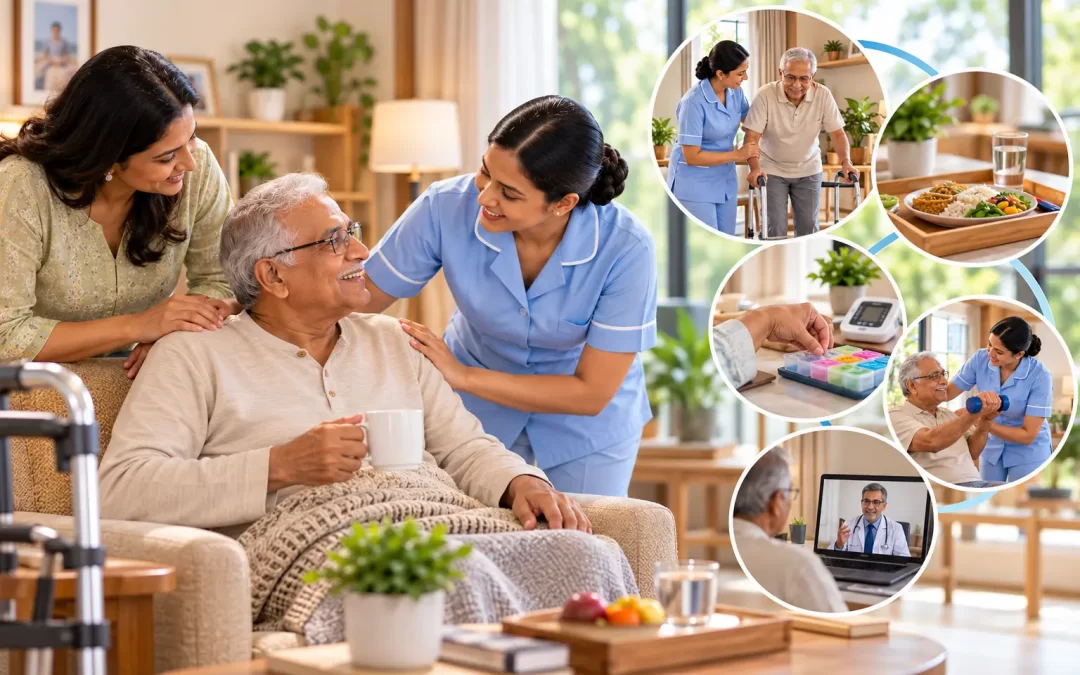
When an older adult leaves hospital, the real risk often starts at the handoff. Families must manage medicines, mobility, follow up visits, nutrition, and daily safety, often while deciding between home care, rehabilitation, or closer supervision. KITES frames this period as out of hospital care for seniors, a structured transition from discharge to recovery and, when needed, longer term geriatric support.
- What is out of hospital care? – It is care delivered after an older adult leaves the hospital but still needs medical, rehabilitation, or daily living support. KITES positions it as a continuum that can include step down care, post hospital rehabilitation, and ongoing elder care.
- Who needs transition care? – Seniors recovering from surgery, illness, weakness, falls, or a complex hospitalization often need more than routine family support. They may require coordinated monitoring, medication management, physiotherapy, and help with activities of daily living.
- How does step down care help? – Step down care provides a safer level of support than unstructured discharge home. It can help bridge the gap between acute hospital treatment and independent living by adding supervision, recovery support, and clinical follow through.
- Why does continuity matter? – Recovery problems often appear across handoffs, not within one isolated service. KITES emphasizes one connected path from discharge to rehabilitation to longer term support so families and clinicians can reduce confusion and respond earlier when needs change.
What is out of hospital care?
Out of hospital care for seniors means the care an older adult receives after leaving the hospital, when hospital level treatment is no longer required but recovery is still incomplete. It sits between acute care and full independence.
This is why a simple discharge is not the same as a safe transition. An older person may be medically stable enough to leave the ward, yet still need wound care, medication support, supervised mobility, physiotherapy, nutrition planning, or help with bathing and transfers.
In practical terms, KITES supports this phase through a connected care journey rather than a single isolated service. That journey can begin at hospital discharge, continue through rehabilitation or step down care, and extend into ongoing geriatric home care or supportive care if recovery is slower than expected.
For families, this matters because search terms often split the problem into parts, post hospital care at home, step down care for seniors, or post surgery rehabilitation for elderly patients. In real life, those needs overlap. Recovery is usually one continuous process.
What happens after discharge?
The first transition is the move from hospital to the next place of care. That may be the home, a rehabilitation setting, or a more supervised care environment. The right choice depends on the older adult’s strength, cognition, mobility, medical complexity, and family capacity.
At this stage, KITES is designed to support several linked needs. One is discharge follow through, making sure instructions do not stay on paper alone. Another is clinical and functional recovery, which may include medication management, mobility support, and geriatric physiotherapy.
A third need is day to day assistance. Some seniors can manage at home with periodic support. Others need help with walking, toileting, bathing, meals, positioning, or observation for warning signs that a family might miss in the first few days after discharge.
This is where transition care differs from routine home help. Transition care for elderly patients is focused on the vulnerable period after hospitalization, when setbacks can appear quickly and the plan must adapt as recovery unfolds.
What is step down care?
Step down care for elderly patients is a level of support used after the hospital phase but before the person is ready for ordinary daily life. It is meant for seniors who are improving, yet still need closer observation and coordinated recovery support.
Families often ask whether step down care is the same as home care. It is not exactly the same. Home care can be part of step down care, but step down care has a transition purpose. It bridges the gap between acute treatment and the next stable routine.
For an older adult after surgery, pneumonia, fracture, stroke related weakness, or prolonged bed rest, step down care can include supervised recovery, medicine administration support, mobility assistance, rehabilitation planning, and monitoring of how the patient manages basic daily functions.
KITES uses this middle stage to connect services that many providers market separately. Instead of treating discharge support, rehab care, and longer term elder care as unrelated decisions, the model makes them part of one care pathway.
How rehabilitation fits
Rehabilitation is often the central phase of out of hospital care. After surgery or illness, many seniors do not just need rest. They need to regain movement, endurance, balance, confidence, and the ability to perform daily tasks safely.
Post surgery rehabilitation for elderly patients may involve physiotherapy, transfer training, walking practice, breathing work, strengthening, and support for safe progression at home. Post hospitalization rehabilitation can also be important after medical illness, not only after operations.
What makes this stage difficult is that recovery is rarely linear. A person may improve in one area and struggle in another. Pain can limit movement. Weakness can increase fall risk. Confusion about medicines can affect appetite, sleep, or blood pressure. That is why rehabilitation works best when it is connected to the broader care plan.
KITES presents rehabilitation as one part of transition care, not a standalone add on. That framing is useful for discharge planners and clinicians because it aligns physical recovery with nursing needs, medication routines, and family readiness at the same time.
When ongoing support matters
Not every senior returns quickly to full independence. Some improve but continue to need elder care, geriatric home care, or supportive care for a longer period. Others may have dementia, frailty, repeated falls, or multiple chronic conditions that make a short recovery plan insufficient.
In these cases, the transition does not end with rehabilitation. It shifts into ongoing assistance that can include personal care, medication management, preventive medical follow through, mobility support, and caregiver guidance. The goal changes from immediate recovery alone to sustained safety and function.
This longer view is part of what distinguishes a transition care approach. KITES is built around continuity across stages, so the family does not need to restart the search every time needs change from discharge help to rehab care to stable ongoing support.
That can be especially important for adult children coordinating care from another city, for clinicians planning a safer discharge, and for families trying to avoid fragmented arrangements after a stressful hospitalization.
Why continuity can help
Hospital discharge for seniors is often messy because information, responsibility, and timing do not transfer neatly. Medicines change. Mobility changes. The home environment may not be ready. Family availability may also change after the first urgent week.
A continuity model can help because it keeps the focus on handoffs. Instead of asking only, “Who will help today?”, it asks, “What support is needed at this stage, and what is likely to change next?” That is the practical value of transition care.
For clinicians and discharge planners, this clearer continuum can support referral decisions. For families, it reduces the common confusion between post hospital care at home, senior rehab services, and ongoing geriatric care. For the older adult, it can create a steadier recovery experience with fewer abrupt shifts.
KITES organizes out of hospital care for seniors around that connected path, from discharge support to rehabilitation to longer term assistance where needed. That makes the care continuum visible, which is often the first step in making it workable.
If your parent is leaving the hospital and the next few weeks feel unclear, start by mapping the transition, not just the first service. The right support plan depends on how much supervision, rehabilitation, and daily help will be needed after discharge, and whether those needs are likely to continue beyond the first recovery phase.
FAQs
1. What is out of hospital care for seniors?
Out of hospital care for seniors is support provided after hospital discharge when an older adult still needs recovery, rehabilitation, medical follow through, or help with daily activities. It can include transition care, step down care, post hospital care at home, and longer term geriatric support.
2. How does transition care reduce hospital readmission?
Transition care can help reduce readmission by supporting the high risk period after discharge, when seniors may struggle with medicines, weakness, follow up instructions, and daily safety. Better coordination across discharge, rehabilitation, and home support can make problems easier to spot and address early.
3. What is step down care for elderly patients?
Step down care is a middle stage between hospital treatment and full independence. It is used when an older adult is stable enough to leave the hospital but still needs supervision, rehabilitation, assistance with daily tasks, or ongoing recovery monitoring.


