
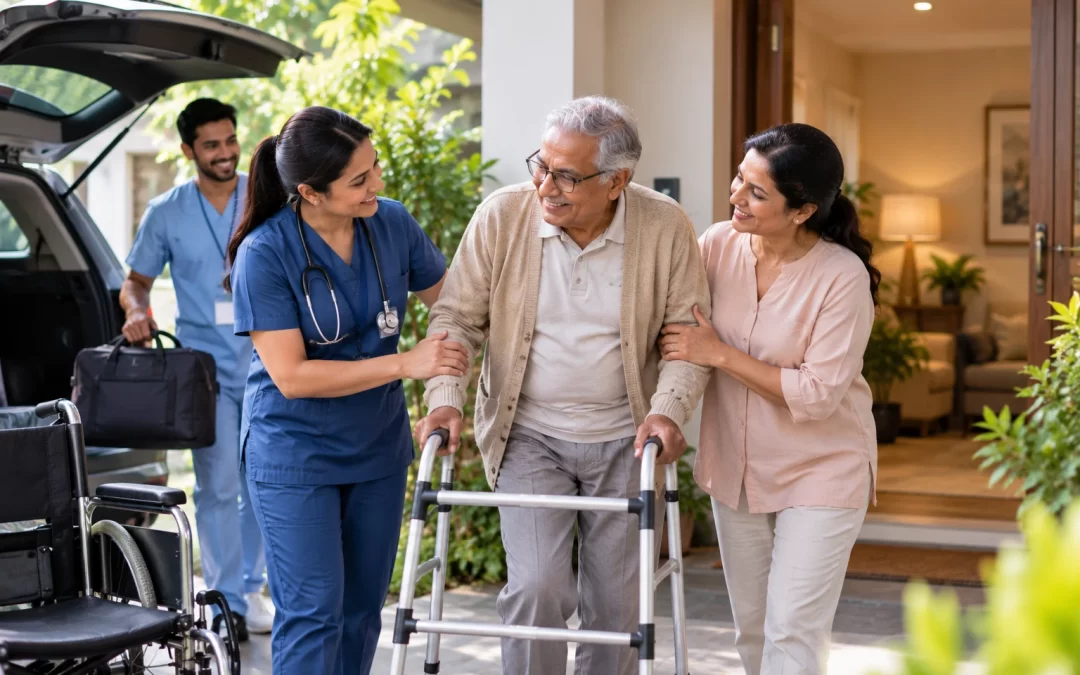
When an older adult leaves hospital, the real risk often starts at home. Medicines change, weakness persists, and families must make daily decisions fast. This guide explains safe hospital to home transitions for seniors in India and frames them within out of hospital care, transition care, and step down care, terms families often hear but may not fully understand.
- What is out of hospital care? – Out of hospital care for seniors is medically supervised support delivered after hospital treatment, usually at home or in a short stay recovery setting. It can include nursing, medication management, rehabilitation, monitoring, nutrition support, and help with daily activities.
- What is transition care? – Transition care is the structured handoff from hospital to home or another recovery setting. For older adults, it should cover discharge planning, medicine reconciliation, follow up appointments, mobility, nutrition, and clear warning signs.
- How does it reduce readmission? – Transition care can help reduce readmission when the care plan is clear, the family understands it, and the senior is monitored for early problems. The goal is to catch decline quickly, prevent medicine errors, and support recovery before a crisis sends the patient back to hospital.
- Who needs step down care? – Step down care is useful for seniors who are stable enough to leave hospital but still need more support than routine home care. This often includes older adults with recent surgery, infection, stroke, frailty, falls, or multiple chronic conditions.
What these terms mean
Families often use post hospital care at home, transition care, and step down care as if they mean the same thing. They overlap, but each has a practical role in recovery.
Out of hospital care is the broader category. It covers clinical and supportive care delivered after discharge, outside the hospital. For seniors, that may include doctor oversight, nursing, geriatric physiotherapy, wound care, oxygen support, medicine supervision, and help with bathing, walking, and meals.
Transition care is the process that connects hospital treatment to safe recovery. It starts before discharge and continues through the first days and weeks after the patient returns home or moves to another setting.
Step down care is for the patient who no longer needs acute hospital treatment but is not yet ready for fully independent living. In practice, this means closer observation, more rehabilitation, and more structured support than a routine caregiver arrangement provides.
For older adults in India, this distinction matters. A family may arrange a caregiver but miss nursing needs, or book home nursing but overlook physiotherapy, nutrition, or fall risk. A strong transition plan brings these pieces together around one recovery goal.
Who needs transition care
Not every discharge is simple. Older adults are more likely to need transition care when recovery is affected by frailty, multiple medicines, reduced mobility, memory issues, or a recent acute illness.
Families should expect a structured plan when the senior has had surgery, pneumonia, heart failure, stroke, a fall, delirium, prolonged bed rest, or a new need for oxygen, feeding support, or wound care. The same applies when the patient lives alone or the main caregiver is stretched thin.
In practical terms, the patient may look stable enough to leave hospital but still struggle with stairs, toileting, appetite, confusion, breathlessness, or keeping track of medicines. That gap between discharge and safe daily function is where transition care matters most.
8 best practices
The safest hospital to home transition for older adults usually follows a small set of disciplined steps. These are the core best practices families and care teams should use.
- Start discharge planning early. Do not wait for the final day. Ask the hospital team what the diagnosis is, what has changed, what the expected recovery path looks like, and what level of help will be needed in the first two weeks.
- Reconcile every medicine. Compare old prescriptions, new prescriptions, stopped drugs, changed doses, and timing. One updated list should show what to take, why it is needed, and what side effects need urgent attention.
- Clarify who is clinically responsible. Families should know which doctor to call for fever, breathlessness, swelling, confusion, falls, low intake, or wound changes. A discharge file without an escalation path is incomplete.
- Book follow ups before discharge. Confirm specialist review, lab work, imaging, dressing changes, and physiotherapy sessions before the patient gets home. Delays in follow up often become avoidable setbacks.
- Assess mobility and fall risk. Check transfer ability, walking distance, balance, pain, stair safety, bathroom access, footwear, and need for walkers, rails, or bedside support. Mobility failure is a common reason recovery stalls.
- Plan food, fluids, and bowel care. Older adults recovering from illness often eat less, drink less, and become constipated. Nutrition and hydration support should be written into the plan, not left to guesswork.
- Prepare the home environment. Arrange a safe bed height, night lighting, clear walking paths, reachable toilets, seating with arm support, and a clean area for medicines and wound supplies.
- Monitor for early warning signs. Recovery is safer when someone tracks symptoms, sleep, intake, urine, bowel movements, pain, blood sugar if relevant, and functional ability from day to day.
These practices are simple to read but hard to execute without coordination. That is why out of hospital care for seniors is more than home nursing alone. It is a managed transition from acute care to stable recovery.
What a good plan includes
A strong transition care plan should be written, shared, and easy to act on. Families should not have to reconstruct it from discharge summaries, memory, and scattered messages.
At minimum, the plan should include the working diagnosis, recent hospital treatment, current medicines, allergies, diet advice, activity limits, wound instructions, physiotherapy goals, follow up schedule, and emergency red flags. It should also name the family caregiver and define who will handle which tasks.
For seniors, the plan should go one step further and address function. Can the person stand safely, use the toilet, swallow tablets, eat enough, manage stairs, and sleep without distress? Medical stability without functional planning is not enough.
| Care area | What should be clear before discharge |
|---|---|
| Medicines | Updated list, dose timing, stopped drugs, side effects, refill plan |
| Monitoring | Vitals or symptoms to watch, who reviews changes, when to escalate |
| Mobility | Transfer status, walking support, fall precautions, therapy needs |
| Nutrition | Meal plan, fluid goals, swallowing issues, supplements if advised |
| Procedures | Wound care, catheter care, oxygen use, dressing schedule |
| Follow up | Doctor visits, tests, transport plan, review timeline |
| Home setup | Bed, bathroom safety, lighting, equipment, caregiver readiness |
This is also where step down care becomes relevant. If the patient needs ongoing observation, frequent clinical review, or intensive rehabilitation, the family should ask whether home is truly ready now or whether a more structured short term setting is safer.
How readmissions happen
Readmissions in older adults are often driven by a chain of small misses rather than one dramatic event. A missed antibiotic dose, poor fluid intake, no follow up on swelling, unsafe transfers, or confusion about insulin timing can all push recovery off track.
Transition care can help reduce hospital readmission because it turns vague discharge advice into monitored action. It creates accountability for medicines, symptoms, mobility, and follow up, especially in the high risk first days after discharge.
That said, not every readmission is preventable. Families should think of transition care as risk reduction, not a guarantee. The value lies in early detection, timely escalation, and better day to day recovery support.
How to assess home readiness
Before bringing an older adult home, families should test the home against the patient’s actual condition, not the patient’s pre illness routine. Many setbacks happen because everyone assumes the senior will function as they did before admission.
Check whether the patient can reach the bathroom in time, turn in bed, sit up without strain, and tolerate essential movement. Ask whether one caregiver can manage transfers safely. If not, additional help or step down support may be needed.
Also consider distance from the treating hospital, availability of lifts, power backup for equipment, and whether key family members can be present for the first 48 to 72 hours. A medically fit discharge can still be an unsafe home arrival.
What families should watch
Families need a short list of red flags after discharge. The exact list depends on the illness, but some warning signs are common across many older adults.
Watch for worsening breathlessness, fever, chest pain, sudden confusion, reduced urine, repeated vomiting, new swelling, falls, severe constipation, poor intake, uncontrolled pain, bleeding, wound discharge, or marked drowsiness. Any sudden drop in walking ability or alertness also matters.
Do not wait for symptoms to become dramatic. In older adults, decline can be subtle at first. A quiet change in appetite, sleep, balance, or responsiveness may be the first sign that the transition plan needs medical review.
When home care is enough
Home based out of hospital care may be appropriate when the older adult is medically stable, the home is safe, the family can support daily care, and clinical review can be arranged without delay. This option often suits seniors who need monitoring, medicine support, physiotherapy, and help with activities of daily living.
Home is often preferable when the patient is easily disoriented by new environments, has strong family support, or can recover with moderate supervision rather than continuous observation. The key question is not comfort alone, but whether the care intensity matches the risk.
When step down care fits
Step down care may be the better option when the patient is stable enough to leave acute care but still needs a higher level of monitoring, rehabilitation, or nursing than routine home support can provide. This can apply after major surgery, stroke, serious infection, prolonged bed rest, or complicated medication changes.
Families should also think about step down care when transfers are unsafe, night time needs are heavy, wound care is complex, or the main caregiver cannot realistically manage the workload. The goal is short term recovery support, not unnecessary institutional care.
In plain language, step down care sits between hospital and ordinary home recovery. For many seniors, that bridge can make discharge safer and more realistic.
For families planning post hospital care at home, the best next step is to build the recovery plan before discharge day, not after. Ask clear questions, document the medicines and follow ups, test whether the home is truly ready, and match support to the senior’s real needs. A safe transition is less about one service and more about coordinated out of hospital care that protects recovery in the days that matter most.
FAQs
1. What is out of hospital care for seniors?
Out of hospital care for seniors is medical and supportive care delivered after hospital treatment, outside the hospital. It may include home nursing, medication management, rehabilitation, monitoring, nutrition support, and help with daily activities.
2. How does transition care reduce hospital readmission in older adults?
Transition care can help reduce readmission by making discharge safer and more coordinated. It focuses on medicine accuracy, follow up, symptom monitoring, mobility support, and early escalation when recovery starts to slip.
3. What is step down care for elderly patients?
Step down care is short term recovery support for an older adult who no longer needs acute hospital treatment but still needs more monitoring, nursing, or rehabilitation than ordinary home care can provide.
4. What should a hospital to home transition plan include for a senior?
A good plan should include diagnosis, treatment summary, updated medicines, follow up appointments, diet advice, mobility precautions, rehabilitation goals, home safety needs, caregiver roles, and warning signs that require medical review.


