
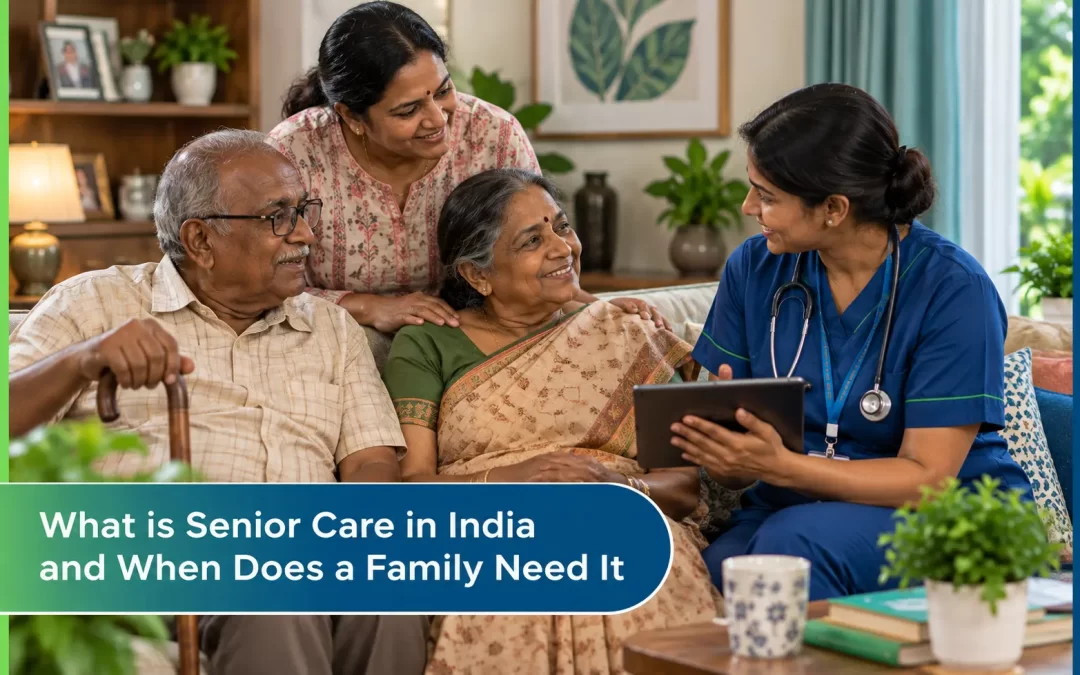
When a parent stumbles on the stairs or forgets to take medication for the third day running, the question stops being theoretical. Families across India face a moment when love alone cannot substitute for structured support. Senior care, as understood in the Indian context, is not about retirement communities modeled on Western living. It is a spectrum of clinical, rehabilitative, and daily living services designed around the realities of multigenerational households, chronic disease prevalence, and a healthcare system where hospital beds are scarce. KITES works within this spectrum, helping families identify exactly what kind of care their elders need and when the right time to seek it has arrived.
What is senior care?
Senior care refers to any organized support that helps an older adult maintain health, safety, and dignity when age or illness limits their ability to manage independently. In India, this includes geriatric home care, skilled nursing, dementia care, palliative care, post hospitalization rehabilitation, and assisted daily living support. The scope ranges from a few hours of physiotherapy each week to round the clock medical supervision at a specialized care center.
Unlike Western models that often center on assisted living facilities or retirement homes, senior care in India typically begins at home. Families prefer keeping elders within familiar surroundings, which means services must travel to the patient. KITES recognizes this preference and structures its care delivery around what Indian families actually need rather than importing frameworks that do not fit local culture, housing, or family dynamics.
Why Indian families delay
Most families in India do not seek professional elder care services proactively. Cultural expectations place caregiving responsibility on adult children, particularly daughters and daughters in law. Admitting that a parent needs outside help can feel like failure. This emotional barrier means families often wait until a crisis, a fall, a hospitalization, or a dangerous medication error, before exploring options.
Financial uncertainty compounds the hesitation. Many families wonder how much senior care costs in India without a clear benchmark. Monthly expenses vary widely depending on whether care is home based or center based, the clinical complexity involved, and the city. Bengaluru, Hyderabad, Chennai, Kolkata, and Coimbatore each have different cost structures. KITES addresses this by offering transparent care assessments that help families understand costs before committing.
When does a family need it?
There is no single threshold, but several recognizable triggers signal that professional senior care should begin. Families who watch for these signs can intervene before a preventable hospitalization or a caregiver’s burnout makes the situation urgent. The following situations represent the most common decision points Indian families encounter.
Frailty and repeated falls indicate that an elder’s physical environment or supervision is no longer adequate. When a parent needs help with bathing, dressing, or walking, assisted care services become necessary. Chronic conditions such as diabetes, hypertension, or COPD that require daily medication management and regular monitoring also push families toward structured geriatric care at home.
Memory decline is another powerful trigger. Early signs of dementia or Alzheimer’s disease, including confusion, wandering, and evening agitation, create safety risks that untrained family members struggle to manage. KITES offers specialized dementia care and memory care programs that address behavioral management, cognitive stimulation, and caregiver respite in ways that general home nursing cannot.
Post discharge recovery after surgery or acute illness is perhaps the most time sensitive trigger. A senior returning home after knee replacement, cardiac bypass, or a bout of pneumonia needs structured rehabilitation, not just bed rest. Post hospitalization rehabilitation, transition care, and step down care all fall under this umbrella. Without them, readmission rates climb and recovery stalls.
Types of senior care explained
Understanding the landscape helps families match their parent’s condition to the right service. Senior care in India is not a single product. It is a collection of distinct service lines, each designed for a specific clinical or functional need. KITES organizes these into clear categories so families can navigate without confusion.
Home based care
Senior home care brings clinical and personal support directly to the elder’s residence. Services typically include medication management, geriatric physiotherapy, wound care, vital sign monitoring, and assistance with activities of daily living such as bathing and mobility. Home based elder care suits seniors who are medically stable but need consistent supervision and skilled nursing visits.
Post surgery rehabilitation
After orthopedic procedures, cardiac surgery, or neurological events, seniors need structured rehab care to regain strength and functional independence. This can happen at home or in a rehabilitation care center. KITES designs individualized rehab programs that include physiotherapy, occupational therapy, pain management, and readmission prevention protocols tailored for elderly patients.
Palliative and hospice care
Palliative care focuses on comfort, pain management, and quality of life for seniors with serious or advanced illness. It can begin alongside curative treatment and is not limited to end of life situations. Hospice care, by contrast, applies when curative treatment is no longer the goal and the focus shifts entirely to dignity and comfort. Both can be delivered at home or in a specialized facility.
Dementia and Alzheimer’s care
Cognitive decline demands a care environment that balances safety with engagement. Dementia care services include behavioral management, structured daily activities, wandering prevention, and caregiver training. Alzheimer’s care follows a similar framework but accounts for the progressive nature of the disease, adjusting the care plan as symptoms evolve through stages. Day care for dementia offers working families supervised daytime support and meaningful respite.
Transition and step down care
Transition care bridges the gap between hospital discharge and full recovery at home. It includes discharge planning support, medication transition, recovery monitoring, and coordination with the hospital team. Step down care provides an intermediate level of medical supervision for patients who no longer need intensive hospital care but are not yet ready for unsupervised home living.
How to choose the right service
Choosing a senior care service for parents in India requires evaluating clinical capability, caregiver quality, and cultural fit. Families should start by identifying the primary need: is it rehabilitation, daily living assistance, cognitive care, or end of life comfort? The answer determines whether home care, a care center, or a hybrid model is appropriate.
Ask potential providers about clinical supervision. A reliable geriatric care service employs trained nurses, physiotherapists, and physicians who specialize in age related conditions. KITES, for example, structures its teams around multidisciplinary geriatric expertise rather than relying on general purpose home nursing staff. Families should also verify whether the provider offers transparent care assessments, regular progress reporting, and emergency protocols.
Cost transparency matters. Families evaluating senior care services in India should request detailed breakdowns that separate clinical fees, caregiver wages, equipment, and consumables. Comparing part time and full time senior home care on both suitability and monthly cost helps families plan sustainably rather than reacting to bills after the fact.
Home care versus care center
This is the question Indian families ask most frequently. Home based senior care preserves emotional comfort and family proximity. It works well for stable chronic conditions, post surgical recovery, and early to moderate dementia. A care center, on the other hand, offers round the clock medical supervision, specialized equipment, and structured rehabilitation environments that are difficult to replicate at home.
The decision often depends on the elder’s clinical complexity and the family’s capacity to coordinate care logistics. A senior with advanced Alzheimer’s who wanders at night may be safer in a memory care center with secure environments. A parent recovering from knee replacement may do better at home with scheduled physiotherapy visits. KITES helps families evaluate both options through structured assessments that weigh medical, emotional, and practical factors.
What senior care costs in India
Costs vary by city, service type, and intensity. Home based geriatric care in metropolitan cities like Bengaluru or Hyderabad typically costs less than center based care, but the gap narrows when round the clock nursing is required. Palliative care and dementia care tend to carry higher costs due to specialized staffing. Families should budget for an initial assessment, ongoing monthly fees, and potential equipment or medication expenses.
KITES recommends that families request a comprehensive care plan with cost projections before starting services. This prevents surprises and allows families to explore insurance coverage, employer benefits, or government schemes that may offset expenses. Affordable senior care is achievable when families plan early and choose providers who offer flexible care packages scaled to actual need.
Signs your parent needs help
Recognizing the moment is half the challenge. Families should watch for weight loss, missed medications, unexplained bruises from falls, social withdrawal, confusion about dates or familiar places, difficulty managing finances, and declining personal hygiene. Any combination of these signs suggests that the current level of family support is no longer sufficient and professional senior care should be explored.
Consulting a geriatric care provider early, even before a crisis, allows families to build a relationship with a care team that understands the elder’s baseline health. KITES encourages preventive medical care assessments for seniors over 65, which can identify fall risk, polypharmacy issues, and early cognitive changes before they escalate into emergencies.
Building a care plan that lasts
A good care plan is not static. It evolves as the elder’s condition changes. Families should revisit the plan every three to six months, adjusting service intensity, adding rehabilitation goals, or transitioning between care types as needed. KITES structures its care delivery around periodic reassessment, ensuring that the support a family receives today still fits six months from now.
Senior care in India works best when families treat it as a partnership rather than a transaction. The right provider becomes an extension of the family, offering clinical expertise, emotional support, and practical guidance through every stage of aging. Starting the conversation early, understanding the options, and choosing a provider with genuine geriatric specialization are the three steps that make the difference between reactive crisis management and proactive, compassionate care.
FAQs
1. What is senior care?
Senior care is organized support that helps older adults maintain health, safety, and daily functioning when age or illness limits independence. In India, it spans home based services like geriatric nursing and physiotherapy, center based rehabilitation, dementia care, palliative care, and assisted living support. KITES delivers these services with a focus on Indian family structures and clinical needs.
2. How do I choose the right senior care service for my parents?
Start by identifying the primary need, whether rehabilitation, daily assistance, cognitive care, or comfort care. Evaluate providers on clinical supervision, caregiver qualifications, cost transparency, and cultural sensitivity. KITES recommends requesting a structured care assessment before committing, which clarifies the right service type and helps families compare home care with center based options objectively.
3. How much does senior care cost in India?
Costs depend on city, service type, and care intensity. Home based geriatric care in cities like Bengaluru or Chennai is generally less expensive than center based care, though round the clock nursing narrows the gap. KITES advises families to request detailed cost breakdowns and explore flexible care packages that scale with actual clinical and personal support needs.
4. What are the best senior care services in India?
The best senior care services in India combine clinical expertise with compassionate, culturally appropriate delivery. Look for providers offering multidisciplinary geriatric teams, transparent assessments, and flexible home or center based options. KITES is designed to meet these standards, covering rehabilitation, dementia care, palliative support, and daily living assistance across major Indian cities.
5. When does an elderly person need senior care?
Common triggers include repeated falls, chronic disease requiring daily medication management, memory decline causing safety risks, post surgical recovery needs, and caregiver burnout within the family. If a parent struggles with bathing, walking, or managing medicines independently, professional senior care can help prevent hospitalization and improve quality of life significantly.
6. Is home senior care better than a care centre?
Neither is universally better. Home care preserves emotional comfort and suits stable conditions or post surgical recovery. A care center offers round the clock supervision and specialized equipment for complex needs like advanced dementia. KITES helps families evaluate both through structured assessments that weigh medical requirements, safety, and the family’s capacity to coordinate care.
7. What is the difference between senior care and elder care?
In practice, senior care and elder care refer to the same spectrum of services for aging adults. Some providers use elder care to emphasize home based support and senior care for broader clinical services. KITES treats both terms interchangeably, focusing on matching the right service, whether rehabilitation, dementia care, or daily assistance, to each family’s situation.
8. Can senior care be provided at home in India?
Yes. Most senior care services in India, including geriatric nursing, physiotherapy, medication management, palliative care, and dementia support, can be delivered at home. KITES structures its home care programs around the elder’s clinical needs and the family’s daily routine, ensuring that professional support integrates smoothly without disrupting the household or the elder’s sense of familiarity.
Internal references
Other articles in this brand’s blog mesh that this piece links to
- Dementia And Alzheimers Care https://kitesseniorcare.com/articles/dementia-and-alzheimers-care/
- How To Choose Elderly Home Care Services For Your Parents https://kitesseniorcare.com/articles/how-to-choose-elderly-home-care-services-for-your-parents/
- Complete Post Surgery Recovery Guide For Seniors From Hospital To Home https://kitesseniorcare.com/blog/complete-post-surgery-recovery-guide-for-seniors-from-hospital-to-home/
- Transitional Care Ensuring Smooth Recovery After Hospital Discharge https://kitesseniorcare.com/articles/transitional-care-ensuring-smooth-recovery-after-hospital-discharge/
- Home Care Vs Assisted Living Whats Right For Your Ageing Parent 1031 https://kitesseniorcare.com/blog/home-care-vs-assisted-living-whats-right-for-your-ageing-parent-1031/
- How To Prevent Fall In The Elderly https://kitesseniorcare.com/articles/how-to-prevent-fall-in-the-elderly/
- Palliative Care Vs Hospice Care A Doctors Guide For Families https://kitesseniorcare.com/articles/palliative-care-vs-hospice-care-a-doctors-guide-for-families/
- Preventive Healthcare Necessity Elderly https://kitesseniorcare.com/articles/preventive-healthcare-necessity-elderly/


