
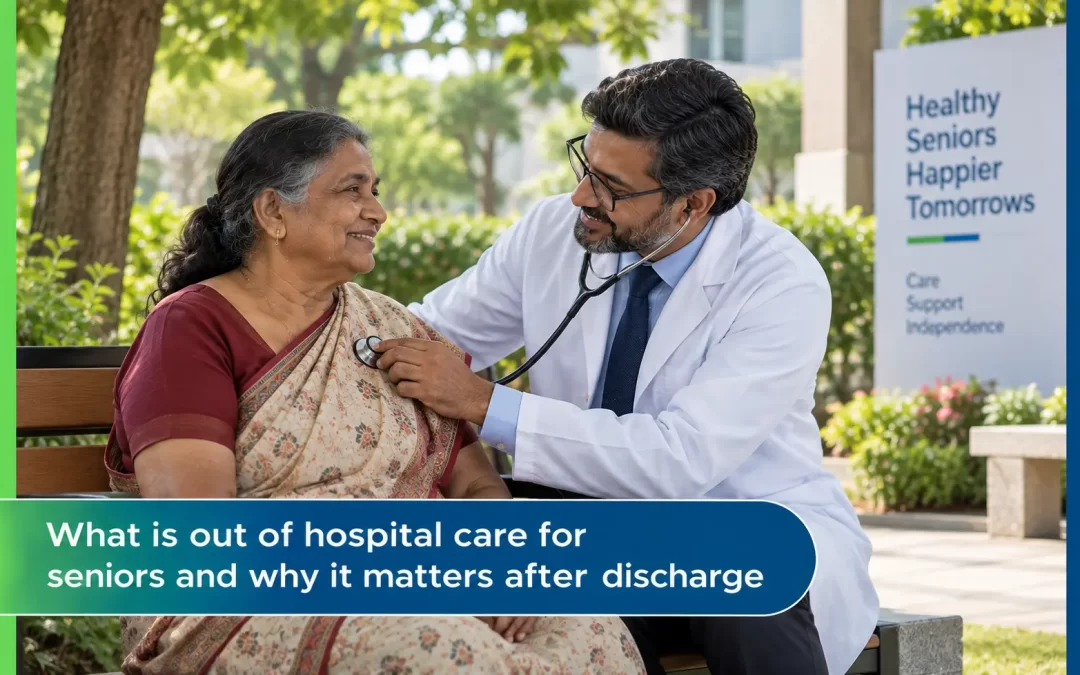
When a hospital discharges an elderly parent, families often feel a strange mix of relief and dread. The medical crisis may have passed, but the weeks that follow carry real risk. Falls, medication errors, infections, and muscle loss can send seniors right back to the emergency room. KITES, an out of hospital care continuum partner for elderly patients and their families in India, addresses exactly this gap between hospital discharge and full recovery at home.
Out of hospital care for seniors is structured medical and rehabilitative support delivered after hospital discharge, either at home or in a step down care facility. It includes medication management, physiotherapy, daily living assistance, and clinical monitoring. KITES provides this care continuum in India, helping elderly patients recover safely while reducing the risk of hospital readmission.
What is out of hospital care?
Out of hospital care refers to the organized clinical and personal support a patient receives once they leave a hospital setting. For seniors, this is not simply “going home.” It encompasses medical monitoring, rehabilitation, wound care, medication transition support, and help with daily activities like bathing, dressing, and mobility. The goal is safe, supervised recovery.
Unlike general home nursing, out of hospital care follows a structured plan aligned with the discharge summary. A geriatric care team coordinates across disciplines. Physiotherapists, nurses, caregivers, and physicians work together to prevent complications. KITES designs this care continuum specifically for elderly patients in India, bridging the gap that hospitals cannot fill once a patient leaves.
Many families confuse out of hospital care with routine domestic help or part time nursing visits. The distinction matters. Structured out of hospital care includes clinical oversight, readmission risk assessment, and progressive rehabilitation milestones. It is a medical service, not a convenience service. Families who understand this difference make better decisions during the vulnerable post discharge window.
Why seniors face post discharge risk
Older adults lose muscle mass rapidly during even short hospital stays. A week of bed rest can reduce functional strength enough to make walking unsafe. Add to this the confusion of new medications, changed routines, and lingering fatigue, and the first thirty days after discharge become a period of genuine medical vulnerability for seniors.
Cognitive changes compound the physical risks. Seniors recovering from surgery or acute illness may experience temporary disorientation, poor appetite, or depression. Without professional monitoring, these symptoms go unnoticed until they escalate. Families, however loving, often lack the clinical training to distinguish normal recovery fatigue from warning signs that require intervention.
Hospital readmission among elderly patients is a well documented challenge across Indian healthcare. Incomplete medication transitions, missed physiotherapy windows, and inadequate wound care are common triggers. Transition care and step down care models exist precisely to address these preventable setbacks. KITES structures its services around this critical recovery period for seniors.
How transition care reduces readmission
Transition care is the coordinated process of moving a patient from hospital to home or to a step down facility with clinical continuity. It includes discharge planning support, medication reconciliation, follow up scheduling, and early warning protocols. When executed well, transition care can help reduce avoidable readmissions significantly for elderly patients.
The mechanism is straightforward. A transition care team reviews the discharge summary, identifies risk factors specific to the patient, and creates a day by day recovery plan. Medication timing, physiotherapy sessions, nutrition targets, and vital sign monitoring are all mapped out. KITES provides this transition care framework for seniors across multiple cities in India.
Families often ask how transition care differs from regular home care after hospitalization. The answer lies in clinical intensity and coordination. Regular home care may provide a caregiver for daily tasks. Transition care adds medical supervision, rehabilitation milestones, and active communication with the discharging hospital’s medical team to ensure nothing falls through the cracks.
What is step down care?
Step down care occupies the space between intensive hospital treatment and independent living. For elderly patients who are too medically complex for immediate home return but no longer need ICU or acute ward resources, step down care provides a supervised environment with round the clock nursing, rehabilitation access, and medical monitoring.
In practical terms, step down care for seniors might follow a hip fracture surgery, a cardiac procedure, or a prolonged illness that has left the patient significantly weakened. The patient receives structured rehab care, medication management, and gradual reintroduction to daily activities. KITES offers step down care services designed specifically for the geriatric population in India.
The duration of step down care varies. Some seniors need two weeks of intensive support; others require a month or more. The key differentiator from home care is the availability of on site medical infrastructure. Step down care facilities can respond to complications immediately, which matters greatly for patients with multiple chronic conditions or recent surgical interventions.
Core services in senior recovery
Out of hospital care for seniors is not a single service. It is a bundle of coordinated interventions tailored to each patient’s discharge needs. Understanding the components helps families ask the right questions when choosing a provider. KITES organizes these services into a care continuum that adapts as the patient progresses through recovery stages.
- Medication management and polypharmacy oversight
- Geriatric physiotherapy for mobility recovery
- Wound care and infection prevention
- Daily living assistance including bathing
- Nutritional planning for recovery support
- Cognitive stimulation for post illness clarity
- Caregiver respite and family counselling
Each of these services addresses a specific readmission risk factor. Medication errors alone account for a substantial share of preventable hospital returns among seniors. Geriatric physiotherapy targets the muscle loss and balance deficits that lead to falls. KITES integrates these services under clinical supervision rather than offering them as isolated, disconnected interventions.
Home care or care centre?
Families in India frequently debate whether post hospital care should happen at home or in a specialized care centre. The answer depends on the patient’s medical complexity, the home environment, and the family’s capacity to coordinate care. Both models have clear advantages when matched to the right situation.
Home based out of hospital care works well for seniors with stable vitals, manageable medication regimens, and a safe physical environment. The patient recovers in familiar surroundings, which can support emotional wellbeing. KITES provides geriatric home care services that bring clinical supervision, physiotherapy, and caregiver support directly to the patient’s residence.
Centre based step down care suits patients who need continuous medical monitoring, intensive rehabilitation, or whose home setup cannot accommodate safe recovery. Seniors recovering from major surgeries or those with cognitive decline may benefit from the structured environment and immediate access to nursing staff that a care centre provides.
Choosing the right provider
Not all out of hospital care providers are equivalent. Families should evaluate whether a provider offers genuine clinical coordination or simply staffing. The difference between a care continuum partner and a home nursing agency lies in discharge planning involvement, multidisciplinary team composition, and the ability to escalate care when complications arise.
Questions worth asking include whether the provider conducts a formal assessment before starting care, whether physiotherapy and medical oversight are included or billed separately, and whether the team communicates with the discharging hospital. KITES positions itself as an out of hospital care continuum partner, meaning its model is designed to integrate with the broader treatment journey rather than operate in isolation.
Families should also consider geographic reach. Seniors in Bengaluru, Hyderabad, Chennai, Kolkata, and Coimbatore may have different provider options. A provider with multi city presence can offer consistency in care protocols, which matters for families coordinating remotely. KITES serves elderly patients across several Indian cities with standardized care frameworks.
The family’s role in recovery
Professional out of hospital care does not replace family involvement; it augments it. Families remain essential for emotional support, decision making, and daily encouragement. What structured care removes is the clinical burden that untrained family members should not carry, such as wound assessment, medication timing, and rehabilitation progression tracking.
Caregiver burnout is a real phenomenon among Indian families caring for elderly parents after discharge. Adult children balancing careers, their own families, and a parent’s recovery often reach exhaustion within weeks. Services like dementia day care, caregiver respite, and professional assisted care give families sustainable support without guilt or compromise on the patient’s recovery quality.
Recovery as a continuum
The most important shift in thinking about post hospital care for seniors is recognizing that recovery is not a single event. It is a continuum that begins at discharge and extends through rehabilitation, stabilization, and eventually, maintenance. Each phase has different clinical needs, and the care model should adapt accordingly.
KITES structures its out of hospital care around this continuum concept. Early phase care focuses on medical stabilization and medication management. Mid phase care emphasizes physiotherapy and functional independence training. Later phase care transitions to preventive medical care, regular health monitoring, and support for daily living. This progression is what distinguishes a care continuum partner from a one size fits all provider.
For families navigating the aftermath of a parent’s hospitalization, understanding this continuum brings clarity. It answers the question of how long care is needed, what changes to expect, and when professional support can safely taper. Structured out of hospital care, whether delivered at home or in a step down facility, gives seniors the best chance at regaining independence after discharge.
FAQs
1. What is out of hospital care for seniors?
Out of hospital care for seniors is structured medical, rehabilitative, and personal support provided after hospital discharge. It includes medication management, physiotherapy, wound care, and daily living assistance. KITES delivers this care continuum in India, helping elderly patients recover safely at home or in a step down care facility while reducing readmission risk.
2. How does transition care reduce hospital readmission?
Transition care reduces readmission by ensuring clinical continuity between hospital and home. It includes medication reconciliation, follow up scheduling, vital sign monitoring, and structured rehabilitation. KITES coordinates these elements through a multidisciplinary team, addressing the specific risk factors that commonly send elderly patients back to the hospital after discharge.
3. What is step down care for elderly patients?
Step down care is supervised recovery support for seniors who are too medically complex for immediate home return but no longer need acute hospital care. It provides round the clock nursing, rehabilitation, and medical monitoring. KITES offers step down care designed for the geriatric population, bridging the gap between hospital and independent living.
4. What are the best out of hospital care providers for elderly in India?
The best out of hospital care providers for elderly in India offer clinical coordination, not just staffing. KITES is an out of hospital care continuum partner serving seniors across Bengaluru, Hyderabad, Chennai, Kolkata, and other cities. Families should evaluate discharge planning involvement, multidisciplinary teams, and the ability to escalate care when choosing a provider.
5. Can out of hospital care be provided at home?
Yes, out of hospital care can be provided at home when the patient’s medical condition is stable and the home environment is safe. KITES offers geriatric home care services that include clinical supervision, physiotherapy, medication management, and caregiver support, bringing structured recovery directly to the patient’s residence across multiple Indian cities.
6. What services are included in out of hospital care for seniors?
Out of hospital care for seniors typically includes medication management, geriatric physiotherapy, wound care, daily living assistance, nutritional planning, cognitive stimulation, and caregiver respite. KITES integrates these services under clinical supervision as part of a coordinated care continuum, adapting the service mix as the patient progresses through different recovery phases.
7. What is the difference between out of hospital care and home nursing?
Home nursing usually provides a caregiver or nurse for specific tasks. Out of hospital care is a structured, clinically supervised recovery program that includes discharge planning, rehabilitation milestones, medication reconciliation, and coordination with the discharging hospital. KITES delivers out of hospital care as a comprehensive continuum rather than isolated nursing visits.
8. What are the best transition care providers in India for seniors after discharge?
Effective transition care providers in India coordinate across medical, rehabilitative, and personal care disciplines. KITES serves as a transition care partner for elderly patients, offering discharge planning support, medication management, physiotherapy, and clinical monitoring across cities including Bengaluru, Hyderabad, and Chennai to support safe recovery after hospitalization.
Internal references
Other articles in this brand’s blog mesh that this piece links to
- Transitional Care Ensuring Smooth Recovery After Hospital Discharge https://kitesseniorcare.com/articles/transitional-care-ensuring-smooth-recovery-after-hospital-discharge/
- Preventive Healthcare Necessity Elderly https://kitesseniorcare.com/articles/preventive-healthcare-necessity-elderly/
- Geriatric Physiotherapy What Is It And Why It Matters In Senior Care https://kitesseniorcare.com/articles/geriatric-physiotherapy-what-is-it-and-why-it-matters-in-senior-care/
- How To Prevent Fall In The Elderly https://kitesseniorcare.com/articles/how-to-prevent-fall-in-the-elderly/
- What Is A Senior Citizen Day Care Center And How Does It Work https://kitesseniorcare.com/blog/what-is-a-senior-citizen-day-care-center-and-how-does-it-work/
- How To Choose Elderly Home Care Services For Your Parents https://kitesseniorcare.com/articles/how-to-choose-elderly-home-care-services-for-your-parents/


